
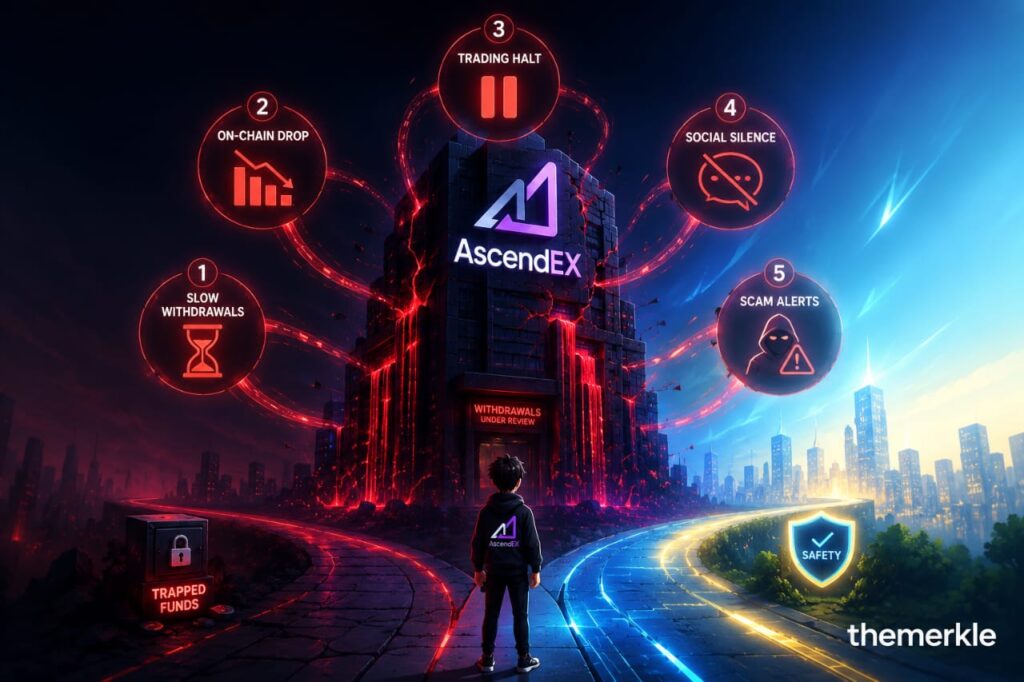
I’ve read enough shutdown notices, like the recent one from AscendEX, to recognize the shape of a collapsing exchange before I finish the first paragraph.
They arrive dressed as routine compliance updates, citing “regulatory considerations” or “market conditions,” but by the time you reach the part where they can’t guarantee your withdrawal, the platform has usually been dying for weeks.
The AscendEX collapse gives us a fresh, well-documented case to work from, and I want to walk through it not as another obituary for a dead exchange, but as a template for spotting the next one before your money is trapped inside.
What AscendEX Actually Told Its Users
The company’s own notice is the place to start, because everything else is reconstruction and this part isn’t. AscendEX told account holders it would cease operations with effect from 1 July 2026, citing regulatory developments including the EU’s Markets in Crypto-Assets Regulation, under which it held no authorization, alongside broader regulatory, financial and operational considerations.

From that date, clients could no longer open accounts, deposit assets, trade, swap, stake, lend, or take part in referral or promotional campaigns, with account access narrowed to offboarding functions like withdrawal requests, KYC updates and transaction exports. Then, on July 6, the second shoe dropped: every withdrawal request became subject to manual review, with automated withdrawals paused entirely.
What stopped me was the sentence buried in that same letter, and it’s worth quoting because the company chose these exact words for a reason, they read like something written by lawyers protecting the exchange rather than reassuring the customer: “Withdrawals may be delayed, or may not be processed during the review period. The timing or amount of withdrawals cannot be guaranteed at this time.” That’s not hedging. That’s an exchange telling you, in writing, that it may not be able to give you your money back and isn’t sure how much of it exists to give.
Later in the same notice, AscendEX admitted it had been counting on a deal that fell through, it had relied on an agreed strategic transaction, and the counterparty simply didn’t perform. That single line does more explaining than the MiCA framing does. A licensing gap is a bureaucratic problem. A counterparty failing to deliver on a liquidity arrangement is a solvency problem wearing a regulatory disguise.
Sign 1: Deposits Keep Flowing While Withdrawals Quietly Slow
A company in trouble wants your money coming in more than it wants to explain why it’s not going out. Watch for:
- Deposits, trading, staking, and lending still running normally
- Withdrawal requests suddenly routed through “manual review”
- Automated withdrawals paused with no clear restart date
- Vague reassurance language replacing specifics on timing or amount
Sign 2: On-Chain Data Is Already Sounding the Alarm
Official notices tell you what a company wants you to know when it’s already too late to act on it. On-chain data doesn’t wait for permission. Reserve records reviewed by Protos showed AscendEX’s total balance dropped by over $240 million on June 20, 2026, a sudden collapse that came less than two months after a liquidity injection of roughly the same size, before which the exchange’s reserves had sat steadily around $50 million. Money arrived, briefly inflated the books, then vanished within weeks. That pattern, a large, temporary balance that exists just long enough to look reassuring, is one I’d tell any reader to treat as an active red flag rather than a reassurance.
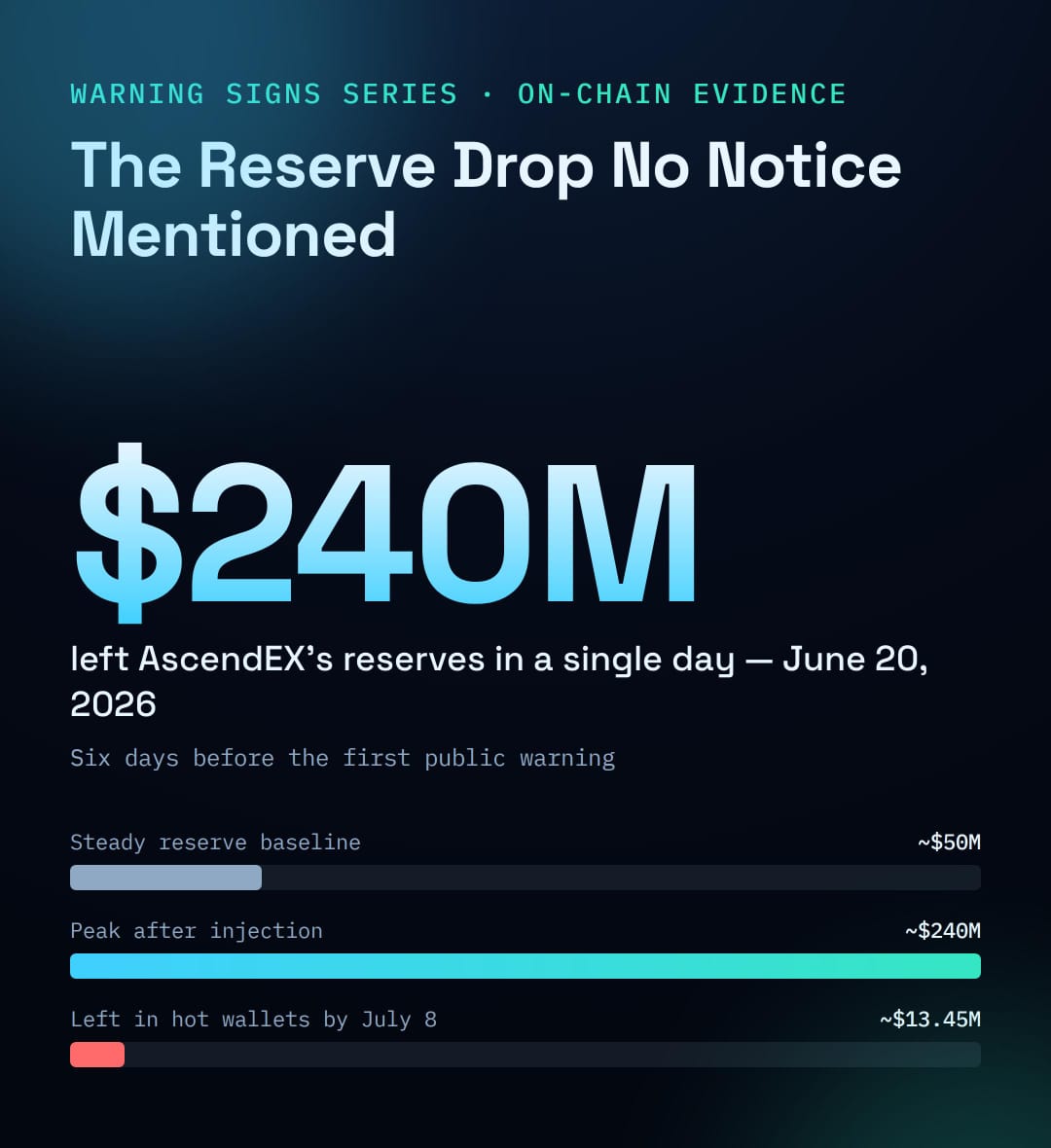

By the time investigator ZachXBT raised the alarm publicly, the picture on-chain was already stark. Arkham Intelligence data showed that as of July 8, AscendEX-labeled addresses held roughly $13.45 million in crypto assets, with more than $12 million of it concentrated in the exchange’s own ASD token and a partner project’s UNITE token, neither one liquid enough to fund withdrawals at any meaningful scale. An exchange that’s actually solvent doesn’t need to be caught holding its own token as collateral for other people’s money.
Sign 3: A Trading Halt Explained in Vague, Security-Flavored Language
Here’s the part of the timeline I think gets skipped over too quickly. Before any of the withdrawal panic, before ZachXBT’s first post, AscendEX had already halted trading on two stablecoins back in May 2026, attributing it to irregular token minting activity tied to a security incident. On its own, that reads like routine exchange housekeeping, coins get frozen for security reasons all the time, and most of those really are benign. But laid against what came six weeks later, it’s the first domino. The lesson isn’t that every trading halt signals collapse. It’s that a halt explained in vague, security-flavored language deserves to be filed away and revisited if anything else goes wrong afterward, rather than forgotten the moment normal trading resumes.
Sign 4: The Company Goes Quiet
Social silence is one of the most legible signals in this whole story, because it requires no blockchain literacy to read. By July 2, ZachXBT reported that AscendEX’s official X account had gone inactive for nine consecutive days since his initial warning, and a major affected user said repeated attempts to reach AscendEX cofounder George Cao went unanswered. A functioning company facing a solvable problem talks to its users, even if the message is uncomfortable, you saw that with the notice itself, hedged as it was. A company that goes dark on the channel it normally uses to reach customers is usually not managing a PR problem. It’s managing an internal one it doesn’t yet have language for, or doesn’t want to put in writing before lawyers get involved.
Sign 5: Recovery Scammers Show Up Before the Exchange Even Confirms a Problem
The last pattern worth naming isn’t about the exchange at all, it’s about what happens around it. Once withdrawal delays became public, users with stuck funds started getting approached by so-called recovery services promising to retrieve frozen money for an upfront fee. This is a well-worn secondary scam, and it works precisely because it targets people who are already anxious and looking for anyone who sounds like they have a solution.
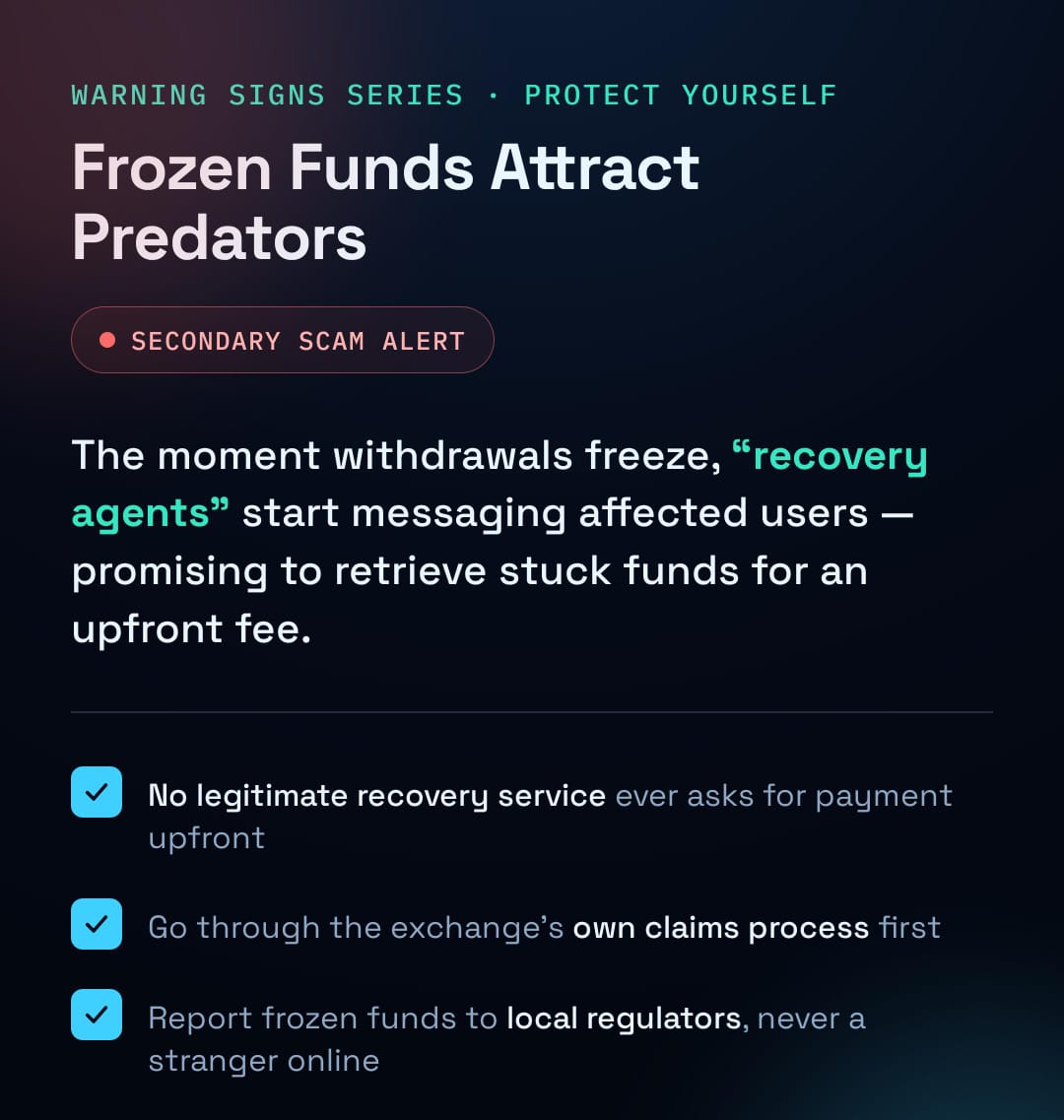

If your funds are frozen at a collapsing exchange, the honest paths forward run through the exchange’s own claims process, your local regulator, and in more serious cases law enforcement, never through a stranger who found you in the replies promising a shortcut.
Putting the 5 Signs Together
Pull the AscendEX specifics out and what’s left is a sequence that repeats across nearly every centralized exchange failure I’ve covered:
- Deposits keep flowing while withdrawals quietly slow – a company in trouble wants your money coming in more than it wants to explain why it’s not going out.
- Trading halts get explained in vague, security-adjacent language rather than anything concrete.
- On-chain reserve data moves days or weeks before any public statement catches up to it, which is exactly why the blockchain is worth checking directly rather than waiting on official word.
- Official social accounts go unusually quiet right as questions start piling up.
- A regulatory deadline gets named as the trigger, even when the underlying problem is clearly financial and customer communications shift into hedged, lawyer-shaped language, with phrases like “cannot guarantee timing or amount” telling you the truth in the only way the company currently feels safe doing.
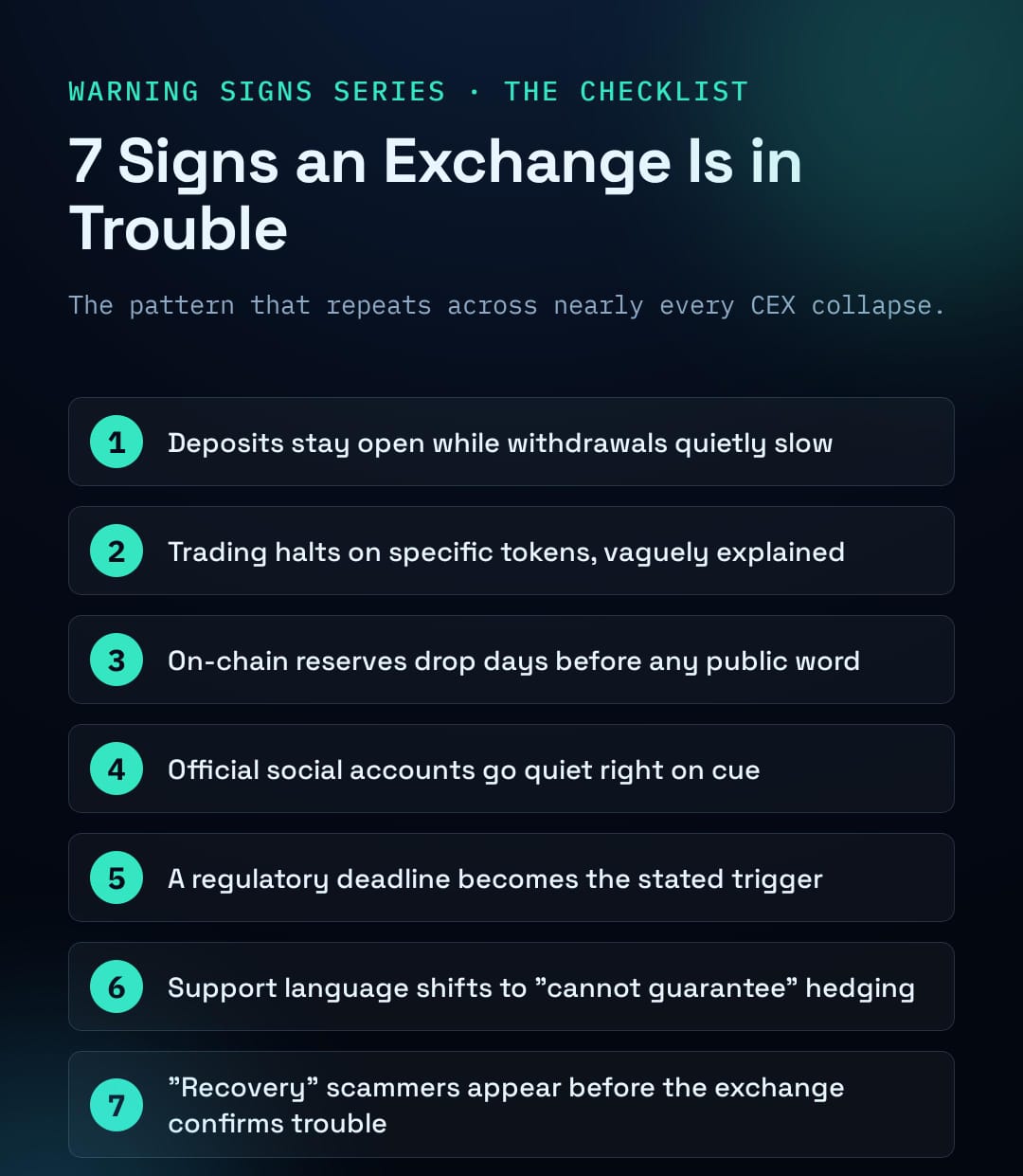

None of these signs is damning on its own. Trading halts happen at healthy exchanges. Social accounts go quiet for boring reasons sometimes. But when two or three of these line up in the same stretch of weeks, that’s not noise anymore, that’s the shape of a wind-down happening in slow motion, and the users who get their funds out are almost always the ones who noticed early rather than the ones who read the official notice when it finally arrived.
Disclosure: This is not trading or investment advice. Always do your research before buying any cryptocurrency or investing in any services.
Follow us on Twitter @themerklehash to stay updated with the latest Crypto, NFT, AI, Cybersecurity, and Metaverse news!