
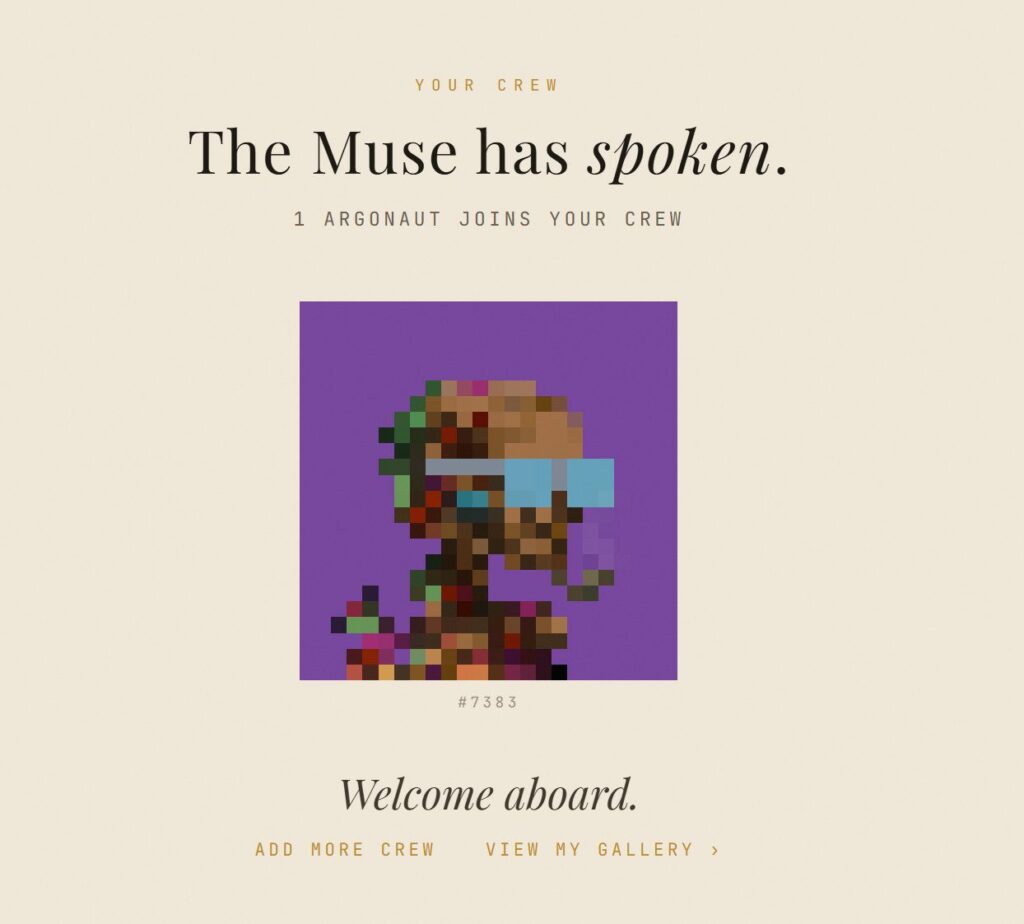
Today, Argonauts by a.c.k. (@lphaCentauriKid) minted at roughly 0.12 ETH, or about $300, and sold through its 10,000-piece collection in just minutes.
That matters.
Not because of the floor price.
Not because of the immediate secondary market.
Not because traders are trying to squeeze a few dollars out of a mint.
The interesting part is who showed up and why they showed up.
Argonauts feels like a collection built for people who already understand a.c.k.’s work — artists, collectors, longtime fans and people who genuinely appreciate crypto-native art.
And that may be a much bigger story than the mint itself.
ACK Has Always Been About the Art
a.c.k. is not approaching Argonauts like a typical NFT founder launching a 10K collection.
He is approaching it like an artist.
That distinction matters.
There is no need to manufacture an elaborate narrative around “utility” to convince people the work deserves value.
The value proposition starts with the artist.
It starts with the work.
It starts with the relationship collectors have developed with ACK’s visual language over years of creating inside crypto.
For longtime collectors, Argonauts isn’t necessarily an introduction to a new brand.
It is another chapter in an artist’s body of work.
And the people showing up understand that.
Look at Who Is Collecting
One of the most interesting things about Argonauts is the culture surrounding the mint.
You are seeing artists collecting artists.
Collectors who have followed ACK for years are participating.
People familiar with his previous works are excited to own something from this larger collection.
That is fundamentally different from the behavior that defined huge portions of the NFT market during the speculative boom.
Back then, many collections attracted people who didn’t particularly care who created the artwork.
They cared about one question:
What does this become worth tomorrow?
Argonauts appears to be pulling the market in another direction.
The question becomes:
Do I want to own this artist’s work?
That is a much healthier foundation for a collecting ecosystem.
NFTs Were Originally About Artists
It is easy to forget this after everything that happened between 2021 and today.
Before NFTs became synonymous with roadmaps, tokens, staking, Discord grinding, metaverses and massive speculative communities, one of the most revolutionary ideas behind the technology was extraordinarily simple:
Artists could create digitally native work and collectors could actually own it.
Blockchain gave digital art something it had historically struggled with:
provenance.
scarcity.
ownership.
distribution.
And perhaps most importantly, a direct relationship between artist and collector.
For digital artists, that changed everything.
Suddenly the internet wasn’t just a place to display artwork.
It could become the marketplace, gallery, provenance system and collector network simultaneously.
That was the breakthrough.
Then the Industry Got Distracted
At some point NFTs became less about the NFT.
Projects became startup companies.
Every collection needed a roadmap.
Every roadmap needed a token.
Every token needed utility.
Every community needed a metaverse.
And suddenly people were buying digital art while spending almost no time talking about the art itself.
The technology became buried beneath layers of promises.
That model produced incredible experimentation, but it also introduced incentives that pushed collectors toward speculation instead of collecting.
Argonauts feels refreshingly different.
The proposition is much simpler.
ACK made art.
People who like ACK’s art wanted it.
They minted it.
That should not feel revolutionary.
But after the last several years, somehow it does.
A Shift From Speculators Back to Collectors
The NFT market does not need another 2021.
It needs something better.
It needs collectors who understand why digital ownership is interesting.
It needs artists experimenting with the medium.
It needs collectors supporting those artists because they believe the work matters.
It needs people who are comfortable owning something even if there isn’t a token coming three months later.
And importantly, it needs artists collecting other artists.
That creates culture.
When artists, collectors and genuine fans form the center of an ecosystem, something very different happens than when the ecosystem is dominated by people looking for the fastest trade.
Taste begins to matter again.
Reputation matters.
Provenance matters.
Artistic history matters.
The relationship between the artist and collector matters.
Those are the foundations upon which meaningful art markets have always been built.
The 10,000-Piece Format Makes It Even More Interesting
There is another interesting aspect to Argonauts.
Historically, collecting established crypto artists can become prohibitively expensive.
As artists grow in reputation, their early work often moves into collections where the price becomes inaccessible to most people.
Large edition projects can change that dynamic.
A 10,000-piece collection creates a much wider entry point into an artist’s ecosystem.
Suddenly someone who has admired ACK’s work for years but could never justify purchasing a major 1/1 has another way to participate.
That matters.
Because crypto art should not only be accessible to whales.
One of the promises of NFTs was that digital distribution could expand the collector base dramatically.
Argonauts represents that idea nicely.
Thousands of people can own a piece of an artist’s broader body of work.
The Sellout Is the Signal
Selling roughly 10,000 pieces at around $300 each in minutes is obviously impressive.
But the monetary number isn’t the most important part.
Demand is the signal.
After multiple brutal NFT market cycles, people are still willing to put meaningful money behind crypto-native artists.
That should tell us something.
NFT collectors did not disappear.
They became more selective.
The market didn’t necessarily stop caring about NFTs.
It stopped caring about NFTs that didn’t give people a compelling reason to care.
An artist with an established body of work is a reason.
Great art is a reason.
Community around an artist is a reason.
Being part of an evolving artistic movement is a reason.
Those reasons existed before the speculation.
And they may ultimately survive long after it.
Maybe This Is the Next Era of NFTs
The next NFT cycle may look very different from the last one.
Maybe the biggest collections will not necessarily be the ones promising the most utility.
Maybe collectors increasingly ask who the artist is before asking what the roadmap says.
Maybe provenance becomes more important than perks.
Maybe the best communities form naturally around genuine appreciation rather than financial incentives.
And maybe NFTs return to being primarily what made them fascinating in the first place:
a new medium for artists and collectors.
Argonauts feels like a small but meaningful example of that shift.
Thousands of people didn’t just mint another NFT today.
They collected an artist.
And there is an enormous difference between those two things.
If this is where the NFT market is heading next, it may be one of the healthiest developments the space has seen in years.
TL;DR
Argonauts by a.c.k. sold through its roughly 10,000-piece collection in minutes at around 0.12 ETH per mint.
The important story isn’t speculation or secondary-market prices.
It’s that the collection appears to be attracting artists, established collectors and longtime fans of ACK’s work.
That points toward a larger shift in NFTs: away from endless utility promises and short-term speculation and back toward artists, art, provenance and collecting.
NFTs were revolutionary because they gave digital artists a native ownership layer and allowed collectors to directly participate in their work.
Argonauts feels like a reminder of that original promise.
Artists collecting artists. Fans supporting artists. Collectors collecting because they actually want the art.
Maybe NFTs aren’t going backward.
Maybe they’re finally coming home.
Image Source:
https://x.com/Gr1ndhouse_art/status/2092601583116730774