

Every crypto cycle produces a new asset class nobody quite has the tools to measure properly, and Cookie.fun has built its entire business around quantifying the latest one: attention itself.
The platform doesn’t trade tokens, doesn’t run a marketplace, and doesn’t do anything you’d typically associate with a crypto platform’s front page. What it does is track exactly how much of the internet’s attention any given AI agent or crypto project is actually capturing, in real time, and turn that into a number traders are increasingly building strategies around.
What it does is track exactly how much of the internet’s attention any given AI agent or crypto project is actually capturing, in real time, and turn that into a number traders are increasingly building strategies around.
What Cookie.fun Actually Does
Cookie.fun is a decentralized data platform built by Cookie DAO, functioning as what the team describes as the index and data layer for the AI agent economy, tracking both onchain activity and social engagement across the space. You can explore the live platform directly here: https://www.cookie.fun/, and the dedicated AI agents index, which ranks projects by real-time mindshare and market data, is available here: https://agents.cookie.fun/.
At its core, the platform aggregates a genuinely large amount of data, roughly 7TB of real-time onchain and social feeds spanning more than 1,500 tracked AI agents and crypto projects. That scale is what allows it to do something most simple price trackers can’t: cross-reference how much a project is being talked about against how its token is actually performing, and flag the gap between the two.
Understanding The Mindshare Metric
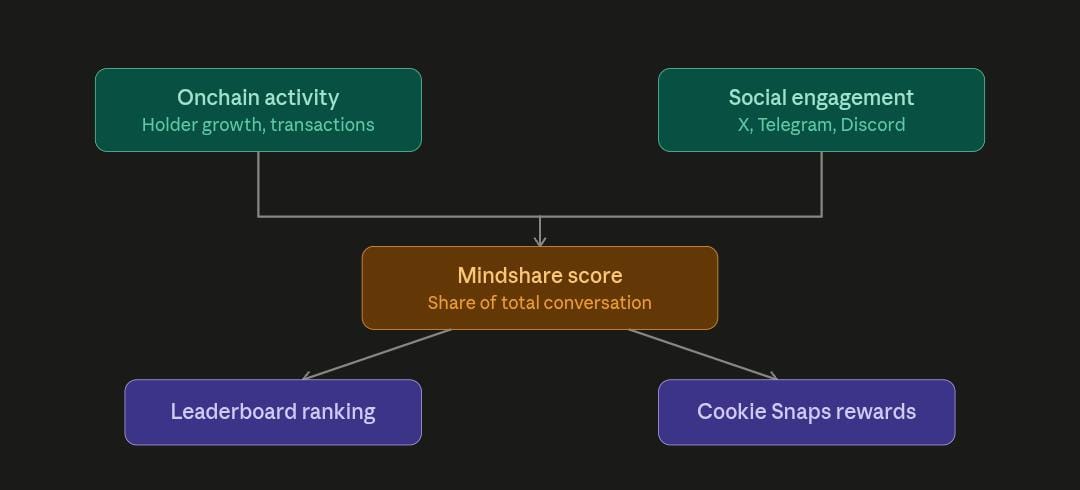
The feature that genuinely sets Cookie.fun apart is its mindshare ranking system. Rather than ordering projects purely by market capitalization, mindshare measures the proportion of total conversation volume attributed to a given agent relative to the overall conversation volume across every other tracked agent, pulled from engagement data across platforms like X, Telegram, and Discord, alongside onchain signals like holder growth and transaction activity.
What makes this genuinely useful, in my view, is that the ranking is explicitly not determined by market cap. That distinction matters, because it means the metric can spotlight a project whose social attention is climbing well before its market capitalization catches up, giving early-moving traders a signal that a pure price chart simply can’t provide. It can just as easily flag the reverse: a project whose price is holding steady while its actual conversation share quietly erodes, often a warning sign that momentum is fading beneath the surface.


How The Platform Turns Attention Into Rewards
Beyond pure analytics, Cookie.fun layers in an engagement-to-reward system called Cookie Snaps, letting users connect their X account, participate in social campaigns run by partner projects, and earn SNAPS points convertible into $COOKIE or partner tokens. According to the project’s own account, more than $4.45 million in total rewards has been distributed across live Snaps and campaign programs, which is a substantial figure for what is, functionally, a rewards-for-engagement layer sitting on top of an analytics tool.
Access to the platform’s deeper analytics and premium dashboard features is gated behind holding and staking at least 10,000 $COOKIE tokens. That requirement functions as both a utility mechanism for the token and a filter meant to align the platform’s most active users with genuine skin in the ecosystem, though it also means the platform’s richest insights aren’t available to casual users who haven’t taken on that token exposure.
The Kind Of Agents That Dominate The Rankings
Since mindshare rankings shift constantly, what’s far more useful, and more honest, is understanding the category of projects that consistently dominate the platform’s leaderboards. Cookie.fun’s rankings have historically been led by established AI agent tokens spanning categories the platform itself organizes around: pure AI agents, infrastructure projects, and DeFAI, meaning AI-driven decentralized finance agents.
Names like GOAT, ai16z, Virtuals Protocol, and aixbt have all featured prominently among the platform’s top mindshare gainers at various points, alongside infrastructure-focused entrants competing for visibility in the broader AI agent narrative. The platform itself is cited as the primary discovery and analytics tool used by AI agent projects including ai16z, which speaks to how embedded Cookie.fun has become specifically within that corner of the market. For anyone wanting the actual current top movers, the live, continuously updated leaderboard is the only reliable source, available directly at the agents index link above.
Where The Platform’s Model Runs Into Real Risk
I don’t think a fair review can skip the genuine structural risks facing this model. The most serious one arrived externally: since January 2026, X has actively begun restricting and, in some cases, blocking accounts engaged in what the platform there considers InfoFi engagement farming, with X’s own product lead publicly framing it as a crackdown on exactly the reward-for-engagement mechanics that Cookie Snaps depends on. That’s a genuinely significant risk for a platform whose rewards layer relies on social engagement that the network hosting that engagement has decided it no longer wants to incentivize.
There’s a second, more structural weakness worth naming plainly: any metric built to reward engagement volume inherently creates an incentive for coordinated, inauthentic activity designed to game the rankings rather than reflect genuine organic interest. Mindshare is only as trustworthy as its resistance to manipulation, and social engagement metrics across the broader crypto industry have a long, well-documented history of being gamed by bot networks and paid engagement farms. Anyone leaning on Cookie.fun’s rankings as a trading signal should weigh that vulnerability seriously rather than treating a rising mindshare score as an automatically trustworthy indicator of organic momentum.

A Fair Assessment Of What Cookie.fun Gets Right
Weighing it all together, I think Cookie.fun has carved out a genuinely distinct and useful niche in a crowded data landscape. Turning a genuinely hard-to-quantify thing, collective attention, into a real-time, comparable metric is a legitimately clever product decision, and the platform’s adoption among serious AI agent projects suggests it’s solving a real problem rather than just packaging vanity metrics. The mindshare-versus-price-action framing in particular gives traders a genuinely different lens than they’d get from a standard price tracker alone.
That said, I’d caution against treating the platform’s numbers as gospel. Between the external pressure from X’s engagement-farming crackdown and the perpetual, unsolved challenge of keeping an attention-based metric honest in an industry with every incentive to manipulate it, Cookie.fun’s long-term reliability depends heavily on factors largely outside its own control. Used as one input among several, it’s a genuinely valuable tool. Used as the sole signal driving real capital decisions, it carries more risk than its clean, confident dashboard design might suggest at first glance.
Disclosure: This is not trading or investment advice. Always do your research before buying any cryptocurrency or investing in any services.
Follow us on Twitter @themerklehash to stay updated with the latest Crypto, NFT, AI, Cybersecurity, and Metaverse news!