

Bitcoin was front and center on my timeline when two completely different stories collided into one, and honestly, the timing couldn’t have been more fitting.
On one side: Bitcoin just ripped through short sellers so hard it produced the largest short liquidation event crypto has ever recorded.
On the other: a very public Twitter fight over whether a trader who claims he lost millions on a Bitcoin short was even trading with real money in the first place. Put them side by side, and you get a pretty honest snapshot of what crypto Twitter actually looks like on a day the market moves this violently, real money getting destroyed for some, and manufactured losses being flexed for clout by others.
The Numbers Behind Crypto’s Biggest Short Squeeze
Let’s start with what actually happened in the market, because it’s genuinely historic. Bitcoin surged to $71,000, up 11.50% on the day, and the move was violent enough to wipe out short sellers on a scale the industry hasn’t seen before.
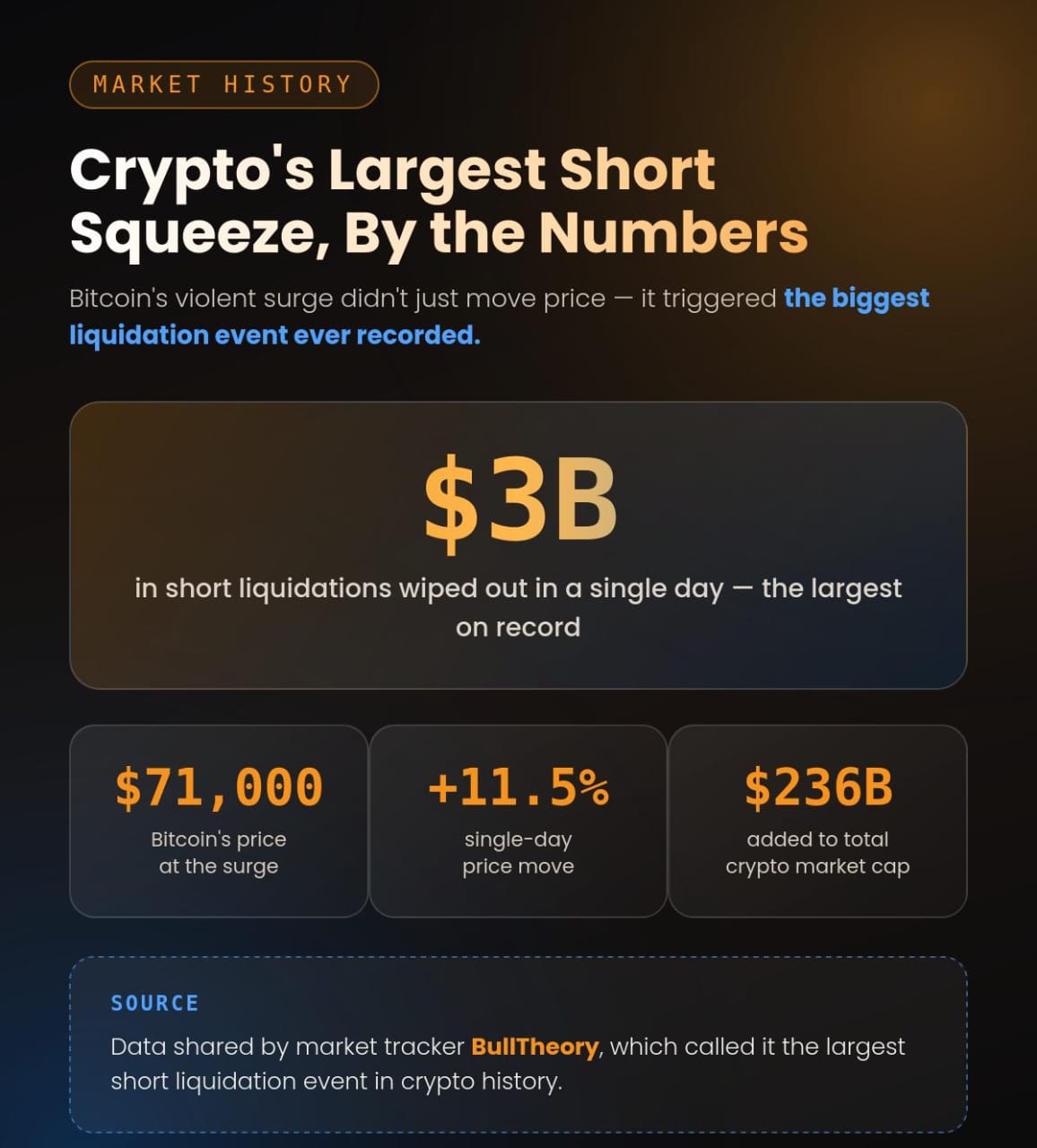

Short sellers lost a combined $3 billion in liquidations in a single day, according to data shared by market tracker BullTheory, which called it the largest short liquidation in crypto history. Alongside that liquidation wave, roughly $236 billion was added to the total crypto market in the same window, a scale of value creation that, even by crypto’s usual standards of volatility, stands out as an unusually sharp single-day swing.

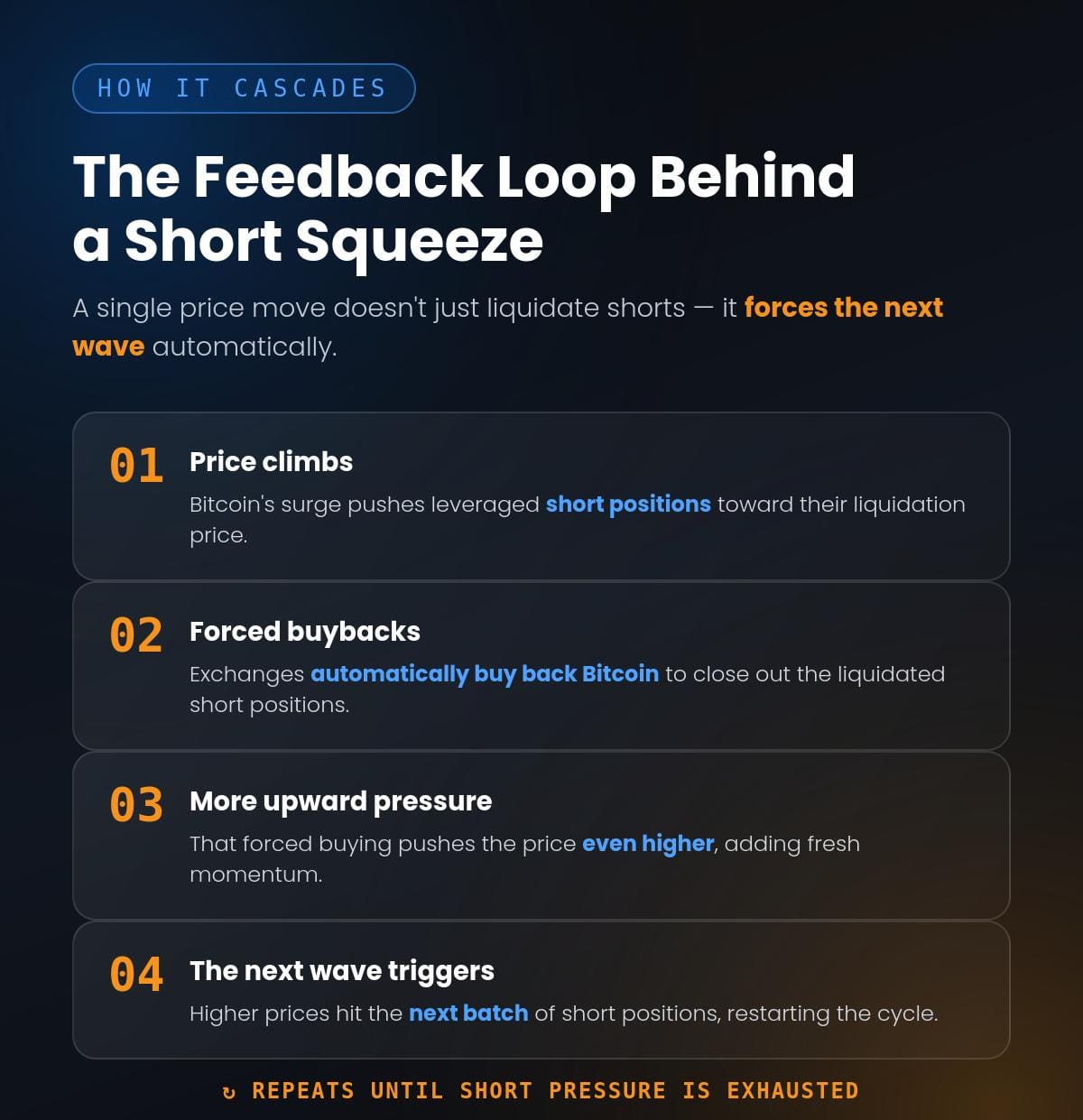
What a move like this actually does, mechanically, is create a feedback loop. As Bitcoin’s price climbs, leveraged short positions start hitting their liquidation price, forcing exchanges to automatically buy back Bitcoin to close those positions out. That forced buying adds even more upward pressure on price, which then triggers the next batch of liquidations just above it. It’s a cascade, and when it happens at this scale, it tends to catch even experienced traders off guard, which brings me to the second half of this story.
When A $6 Million Loss Turned Into A Public Accusation
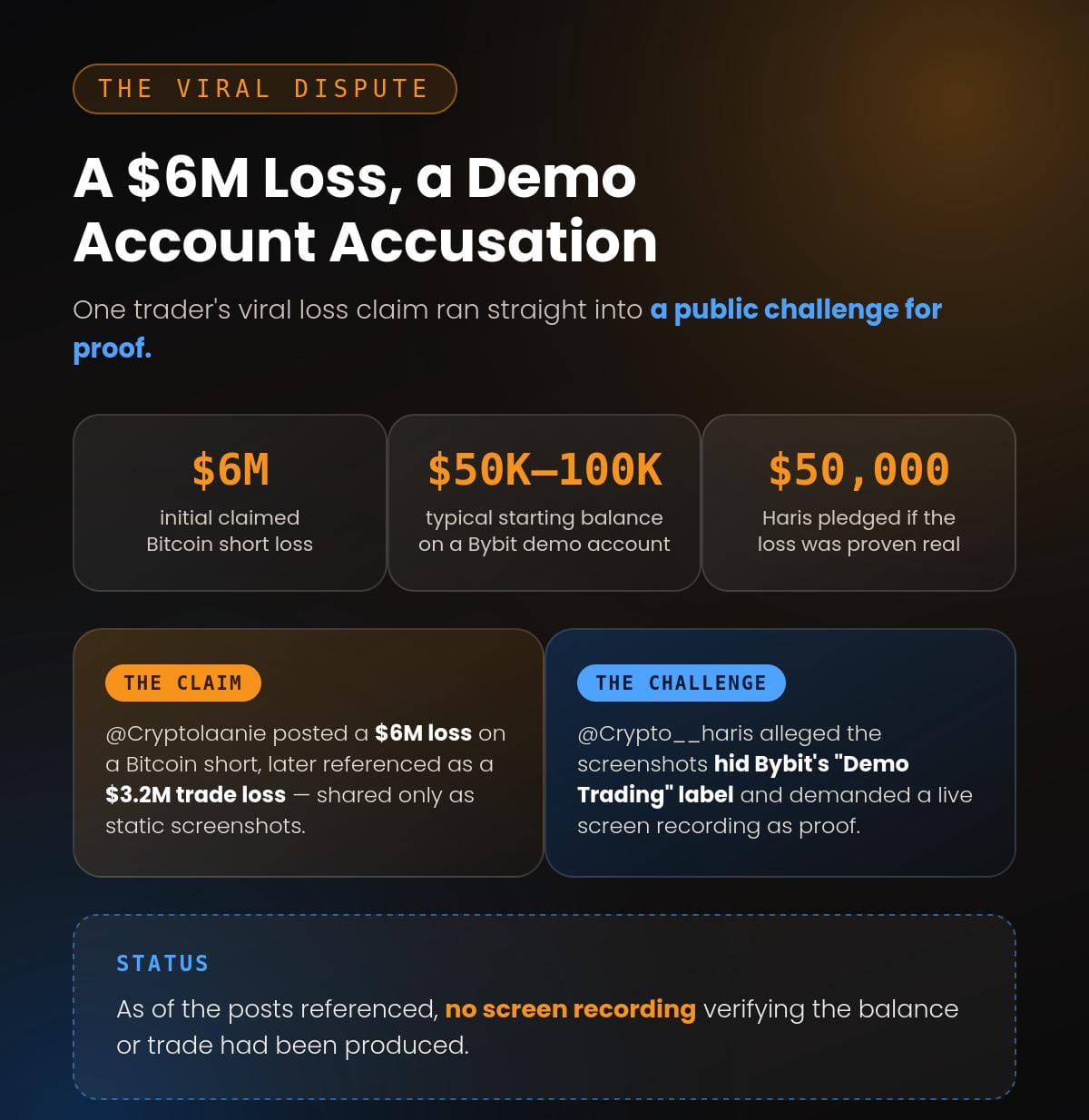
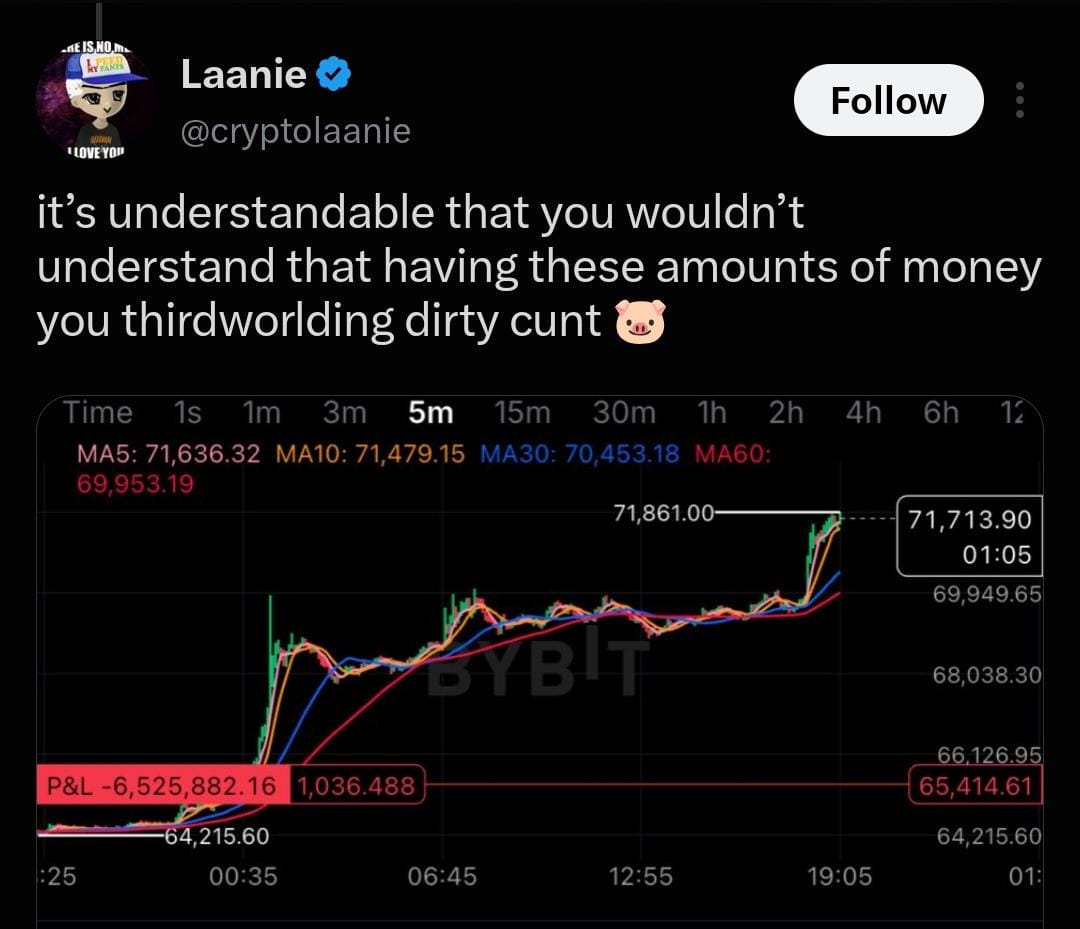
Amid all that volatility, a trader posting under the handle @Cryptolaanie claimed to be down a staggering amount on a Bitcoin short position, initially describing the loss as $6,000,000. On a day when Bitcoin genuinely did move violently against short positions, a loss of that scale wasn’t inherently implausible on its face, that’s exactly what made the story spread as fast as it did.
But another crypto Twitter user, posting as @Crypto__haris,pushed back hard, alleging that the trader was actually using a Bybit demo account rather than real funds, and that the screenshots being shared had allegedly been cropped or edited to hide the “Demo Trading” labeling that Bybit displays on its practice accounts.
It’s worth understanding why this claim is technically plausible at all: Bybit’s own demo trading feature gives users a simulated account loaded with virtual funds, typically starting around $50,000 to $100,000 in test assets, that mirrors live market prices exactly. Users can request additional demo funds indefinitely whenever their simulated balance runs low, meaning a screenshot of a demo account showing a seven-figure balance, gain, or loss is entirely possible to produce without a single real dollar ever being at risk.

The Exchange That Escalated The Dispute
What followed was less a debate about trading and more a public confrontation. According to the thread, when challenged on the legitimacy of the loss, Cryptolaanie responded to Haris with a dismissive and openly derogatory remark, essentially suggesting Haris couldn’t understand what it’s like to have that kind of money at stake, using language that leaned on both classist and vulgar insults rather than addressing the actual accusation.

Haris didn’t let it go. His reply was direct: he called the trader “just a poor editor,” and publicly challenged him to prove the loss was real by posting a screen recording showing both his live wallet balance and the $3.2 million trade loss in real time, rather than a static screenshot that can be cropped or manipulated after the fact. To back the challenge, Haris said he would personally send $50,000 if the recording confirmed the claim. As of the posts referenced here, no screen recording verifying the balance or trade had been produced.
Why This Kind Of “Larping” Is A Recurring Problem In Crypto
I want to be careful about the framing here, because none of this has been independently verified beyond the claims made by both accounts involved, and readers should treat the accusation as exactly that, an accusation, not a confirmed fact. But the underlying pattern being described is a well-documented one in crypto trading communities. The term “larping,” borrowed from live-action role play, gets used constantly in these spaces to describe traders who fabricate or exaggerate their positions, gains, or losses for social clout, often using demo accounts, edited screenshots, or cherry-picked trades to construct a persona of being a bigger, more successful trader than they actually are.

The reason this matters beyond one Twitter spat is that these fabricated flexes don’t stay contained to entertainment. They shape how newer, less experienced traders perceive risk and reward in leveraged trading, sometimes encouraging people to take on outsized leverage themselves while chasing gains they saw someone else claim, without realizing that claim may have never involved real money at all. Screen recordings, unlike static screenshots, are far harder to fabricate convincingly because they show live wallet interfaces, timestamps, and account labeling in real time, which is exactly why Haris’s challenge, offering real money contingent on real proof, cuts to the heart of the problem rather than just arguing about it.
What A Day Like Today Actually Reveals
Put the two halves of today together and you get a pretty clear picture of where crypto’s biggest risks actually sit right now. The market side is real: a genuine $3 billion short liquidation event, a genuine 11.5% single-day Bitcoin move, and $236 billion in value that came back into the market in a matter of hours. That’s the kind of volatility that can legitimately devastate leveraged short positions, and it’s entirely plausible that plenty of real traders took real losses today chasing a short that Bitcoin simply refused to honor.
But the Cryptolaanie dispute is a reminder that not every viral trading loss on your timeline is what it claims to be, and on a day this volatile, that distinction matters more than usual. When the market itself is producing headline-worthy numbers, it becomes even easier for fabricated or exaggerated claims to blend in and spread, because the real volatility makes the fake losses sound plausible. If there’s a practical takeaway buried in all of this, it’s the same one Haris was effectively pushing for: before taking any trading claim on social media at face value, especially one shaping how you think about risk, ask for a screen recording, not a screenshot. It’s a small habit, but on days like today, it’s the difference between learning from someone else’s real experience and getting played by someone else’s performance.
Disclosure: This is not trading or investment advice. Always do your research before buying any cryptocurrency or investing in any services.
Follow us on Twitter @themerklehash to stay updated with the latest Crypto, NFT, AI, Cybersecurity, and Metaverse news!