
Having tested a fair number of exchange-linked options like KuCoin’s Web3 Wallet over the past year, I’ve noticed most follow the same script: store your tokens, connect to a few DApps, maybe bolt on a swap function, and call it a day.
So when I sat down to actually use KuCoin’s Web3 Wallet properly, rather than just skim the marketing page, I expected more of the same.
I did not expect to end up placing a prediction market trade on a World Cup match from inside what is technically a crypto wallet. That single moment told me more about where exchange wallets are heading than any press release could.
What Makes KuCoin Web3 Wallet Different From The Rest
On paper, KuCoin’s Web3 Wallet reads like every other self-custodial, multichain wallet pitch: you hold your own keys, you connect to DApps, you manage assets across networks. But once I dug into what is actually bundled inside it, the scope stood out. This is a wallet that supports more than 20 blockchain networks, ships with a built-in cross-chain DEX aggregator, offers wallet-native perpetual futures trading, gives access to tokenized real-world assets, and layers in Smart Money tools that let you track what informed wallets are doing on-chain, all before you even open a single DApp.
What I think genuinely separates it from something like MetaMask is that KuCoin is not trying to be a neutral, exchange-agnostic tool. It is deliberately built as the connective tissue between a centralized exchange account and the decentralized world, which is also its pitch against Binance Web3 Wallet and OKX Wallet. OKX still edges it out on raw Web3 infrastructure depth and DeFi integration in a lot of comparisons I have read, and Binance leans on scale and brand trust, but KuCoin is leaning hard into a different lane: treating the wallet as a single dashboard for everything from token discovery to sports betting-style markets. It is less “portal to Web3” in the abstract sense and more “everything you can currently do with crypto, in one app.”
Inside The Airdrop Hub Where Rewards Actually Show Up
If there is one feature I think casual users underrate, it is the Airdrop Hub. Airdrop farming across a dozen wallets and browser tabs has always felt chaotic to me, but KuCoin consolidates campaign discovery directly into the wallet’s Discover tab. You browse active campaigns, complete milestone tasks like holding a minimum balance or trading a listed token, and rewards get sent straight to your wallet address after an internal review window, typically within five to ten business days depending on the campaign.
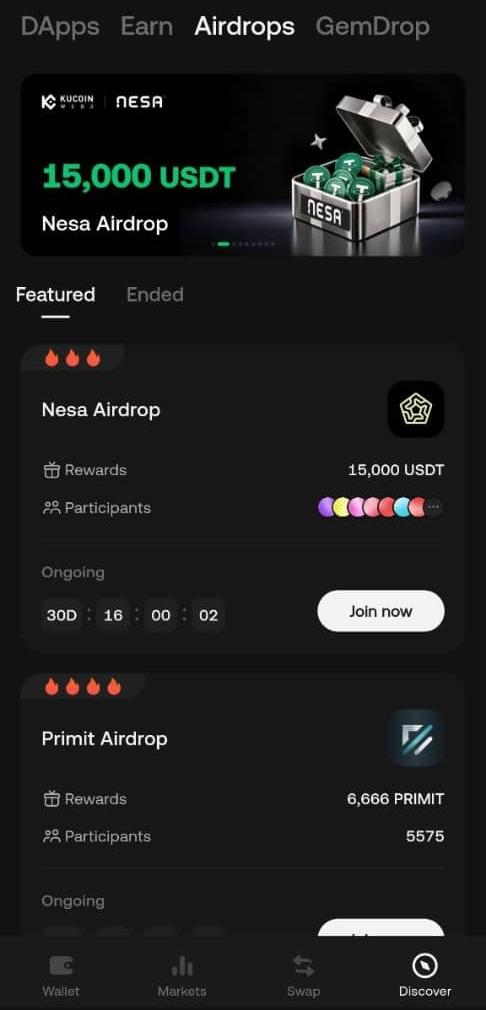

I appreciate that it removes a lot of the guesswork around which unofficial airdrop trackers to trust, since these campaigns run directly through KuCoin’s own infrastructure. That said, I would not call it risk-free. KuCoin is explicit in its own terms that participating tokens are not guaranteed to launch through a proper token generation event, and the platform disclaims liability if a project’s token never materializes or never gains liquidity. It is a genuinely convenient hub, but it does not remove the underlying risk that most airdrop farming still comes down to speculation on projects that may or may not deliver.
The NFT Layer Built Around Windvane
KuCoin’s NFT integration runs through Windvane, its dedicated NFT marketplace, which lets you buy, store, and display collections without leaving the wallet interface. I think this is one of the more underrated design decisions here, because a lot of exchange wallets treat NFTs as an afterthought, a tab you visit once and forget. Windvane being built directly into the wallet experience means your NFT holdings sit alongside your fungible tokens rather than existing in a separate silo you have to remember to check.
Where I have more mixed feelings is on relevance. NFT trading volume industry-wide is nowhere near where it was during the 2021 to 2022 boom that originally justified building marketplaces like this one, and I suspect a fair number of users interact with the NFT tab far less than KuCoin would like. It is a well-built feature attached to a market that has cooled considerably, which makes it feel more like a completeness checkbox than the wallet’s main draw today.
Putting Exchange Loyalty On-Chain: KCS Staking In The Web3 Era
One area where KuCoin’s exchange roots shine through is in how it integrates its native exchange token, KCS. Historically, holding exchange tokens in a self-custodial wallet meant giving up platform-level perks like trading fee discounts or daily bonuses. With KuCoin’s Web3 Wallet, I was curious to see whether holding KCS on-chain felt disconnected from the main exchange ecosystem.
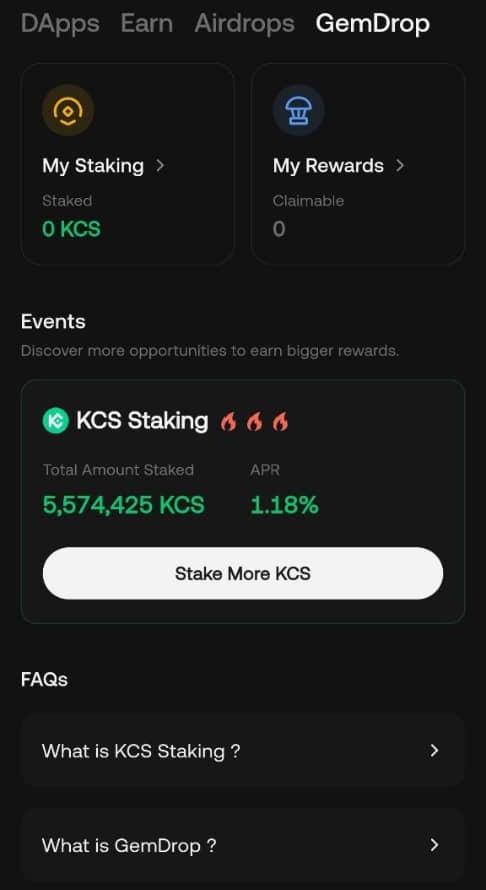

Instead, the wallet bridges that gap by letting you tap into KCS Staking and on-chain liquid staking derivatives (like SKCS) right from the Earn tab. What I noticed immediately is how low the barrier to entry is, you can start staking with as little as 1 KCS. In practice, this means your staked holdings generate daily yield directly inside your self-custodial interface without forcing you to choose between retaining control of your private keys and earning passive returns on your exchange token.
However, I would still offer a reality check here. Staking KCS in a Web3 wallet doesn’t protect you from the token’s underlying price volatility, nor does it entirely replicate the deep VIP tier discounts you might get by holding massive amounts on the centralized exchange. Furthermore, if you choose liquid staking variants, you take on smart contract risk alongside protocol liquidity conditions. Still, as someone who prefers keeping assets in self-custody whenever possible, having a direct on-chain yield mechanism for KCS makes holding the token far more practical than it used to be.
Betting On Reality: The Polymarket Prediction Market Feature
This is the feature that actually surprised me. Through its integration with Polymarket. KuCoin’s Web3 Wallet now lets users trade on event-driven prediction markets, everything from sports outcomes to crypto price milestones to broader news events, without leaving the wallet. I placed a small position on a World Cup knockout match during a KuCoin trading challenge, and the entire flow, from funding to executing the prediction, happened inside the same interface I use to hold my tokens.
I think this matters more than it initially sounds. Prediction markets processed tens of billions of dollars in volume over the past year, and folding that activity directly into a wallet rather than requiring a separate app removes real friction. It also signals something about where KuCoin sees the wallet’s future: not just as a place to hold assets, but as a place to express a view on anything with an outcome. Gas Meng, who leads KuCoin Web3 Wallet operations, has described the goal as making the wallet a gateway that connects on-chain activity to real-world information flows, and having used it, I think that framing is accurate rather than just marketing language.
Perpetuals, RWAs, And The Other Features Worth Knowing
Beyond airdrops, NFTs, and prediction markets, KuCoin has quietly built out wallet-native perpetual futures trading, powered by Hyperliquid’s infrastructure, so you can open leveraged positions with centralized-exchange-level execution speed while still holding your own keys. I found the execution noticeably smoother than I expected from a self-custodial product, though I would still flag that perpetuals carry the same liquidation risk here as anywhere else, self-custody does not soften that.
The wallet also offers access to tokenized real-world assets, giving holders exposure to things like treasury products directly on-chain, and its Smart Money tools let you follow the on-chain footprints of wallets with strong track records. Combined with access to more than 1,000 DApps through the built-in browser, I do not think it is an exaggeration to call this one of the more feature-dense wallets currently shipping from a major exchange.
Where The Wallet Still Falls Short
For all of that, I do not think KuCoin’s Web3 Wallet is without real weaknesses. It has no direct fiat on-ramp or off-ramp, so you are always relying on an external platform or your KuCoin exchange account to move between crypto and cash, which adds a step that wallets like Coinbase Wallet do not require. Network selection, gas fees, and approvals are still handled manually, which can trip up newer users despite the wallet’s otherwise polished interface.
There is also the matter of trust. KuCoin’s exchange has a history of past regulatory and security scrutiny that, fairly or not, still shapes how some users perceive the broader ecosystem, including the wallet built on top of it. And in head-to-head user ratings against competitors like OKX Wallet, KuCoin’s wallet products have generally scored lower on ease of use and feature satisfaction, suggesting the ambition of the feature set has not always translated cleanly into everyday usability. It is a genuinely capable, feature-rich wallet, but I would stop short of calling it the most polished one on the market. What it has instead is range, and for users who want a single app that touches nearly every corner of crypto, that range is a real selling point, even if it comes with some rough edges still worth knowing about before you dive in.
Disclosure: This is not trading or investment advice. Always do your research before buying any cryptocurrency or investing in any services.
Follow us on Twitter @themerklehash to stay updated with the latest Crypto, NFT, AI, Cybersecurity, and Metaverse news!