

Polymarket was one of those crypto teams that didn’t whisper about a token launch, it shouted it, then went quiet, then let one junior engineer carry the entire conversation on his personal social media account for months, until he vanished from the story altogether.
Piecing together two years of posts, trademark filings, and podcast confirmations, a clear pattern emerges: Polymarket committed to $POLY early, loudly, and repeatedly, then watched its own legal team seemingly muzzle the hype it had spent two years building. Here’s the full trail, and what it actually tells traders about whether the token is still coming.
The Loud Years: From A Cryptic App Message To A Billionaire’s Tweet
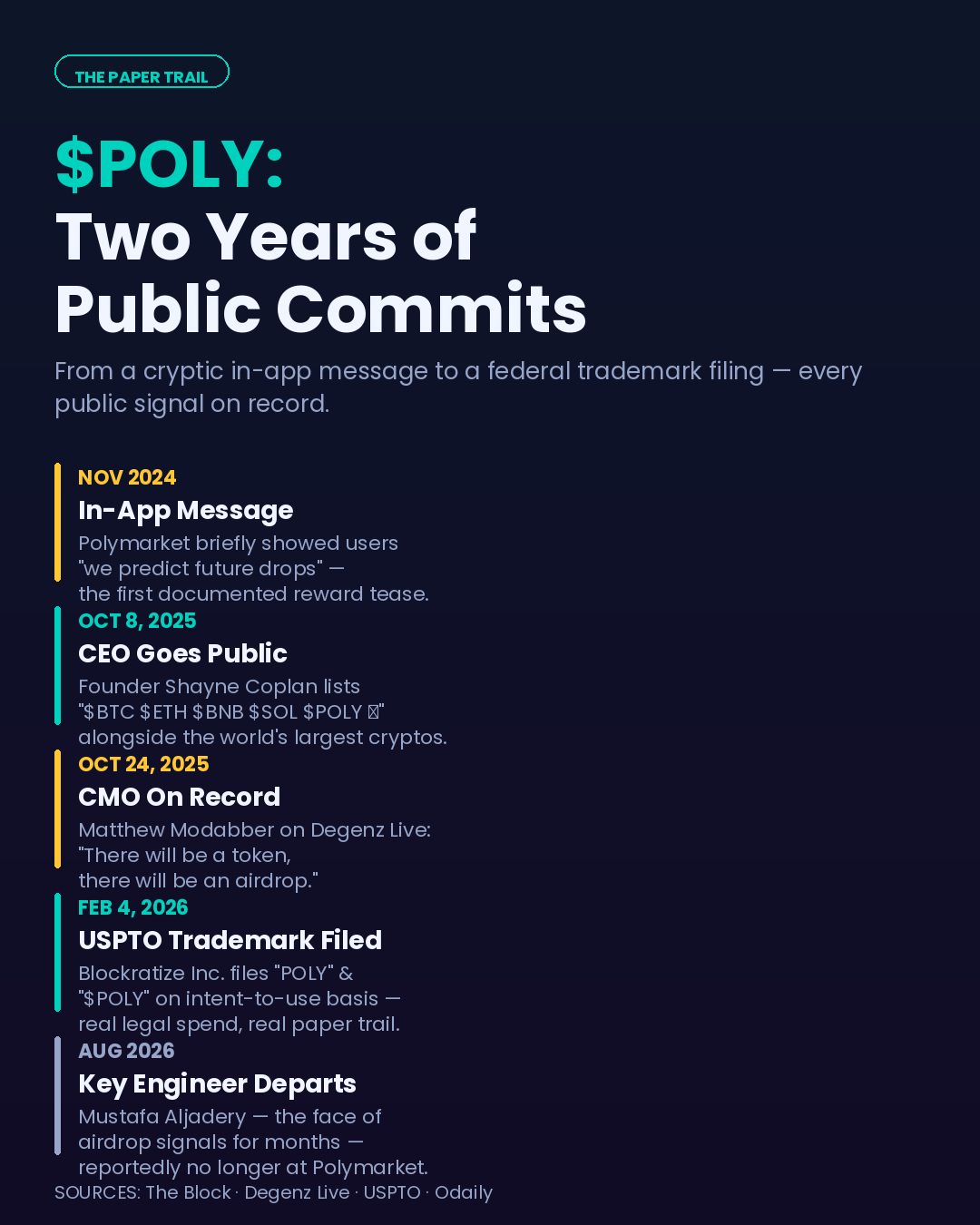
The earliest signal traces back to November 2024, in the chaotic days following Donald Trump’s election win, when Polymarket briefly displayed an in-app message to users reading “we predict future drops.” The Block reported on the message at the time, noting Polymarket had previously discussed raising funds and launching a token, though without firm plans. There’s no surviving public post to link to for this one, it lived inside the app itself rather than on social media, but it’s the first documented moment anyone associated with Polymarket teased a reward for loyal users.
The teasing went fully public on October 8, 2025, when founder and CEO Shayne Coplan posted a now-famous message listing “$BTC $ETH$BNB $SOL$POLY 🤔”, placing his platform’s still-nonexistent token directly alongside the largest cryptocurrencies in the world.

Then came what’s still the single strongest confirmation on record. On October 24, 2025, Polymarket CMO Matthew Modabber appeared on the Degenz Live podcast and stated plainly: “There will be a token, there will be an airdrop.” He added that the team wanted the token to have “true utility” and “longevity,” and that the priority before any launch was completing Polymarket’s US relaunch. That’s about as close to an unambiguous corporate commitment as crypto teasing gets, delivered by the company’s own marketing chief on the record.
The Quiet Turn: When Leadership Stopped Talking And Legal Started Watching
After that October 2025 double-hit, Coplan’s post and Modabber’s podcast confirmation, something shifted. No C-level executive at Polymarket has publicly teased $POLY since. But the signals didn’t stop; they just moved down the org chart.
In November 2025, growth lead William LeGate became the face of airdrop-related communication, directly warning users attempting to game the system. Responding to fears about fake engagement farming allocation, he wrote plainly that sybil-flagged comments would not lead to airdrop allocation and that people pursuing that route were wasting their time.
Then, on February 4, 2026, Polymarket’s parent company Blockratize Inc. took the most legally consequential step yet: filing US trademark applications for both “POLY” and “$POLY” with the United States Patent and Trademark Office. The filings, submitted on an “intent to use” basis, explicitly describe the marks in connection with providing a digital currency for an online community, alongside broader categories covering cryptocurrency trading and financial platform services. The applications remain publicly viewable on USPTO’s own system. Unlike a post, a trademark filing costs money, requires legal sign-off, and creates a paper trail, it’s the strongest piece of documentary evidence that token work was genuinely underway internally, regardless of what was or wasn’t being said publicly.
The Mustafa Era: One Engineer Becomes The Entire Communications Strategy
From roughly this point forward, nearly all public $POLY signaling shifted to one account: Mustafa Aljadery, a Polymarket engineer who describes himself online as the company’s “senior intern.” Other team members, leadership included, went largely silent on the topic.
In February 2026, Mustafa posted and quickly deleted, a screenshot of a coding session showing a task instruction to migrate the platform’s fee collection mechanism from USDC.e to POLY on the staging branch, according to reporting from Odaily and Bitget News at the time. Around the same period, he also publicly replied “1m markets and $POLY next” to a major Polymarket trader, and in March 2026 teased a “big announcement” coming that Monday, tagging it with a coin emoji that fueled further speculation. Screenshots and photos tied to his desk and laptop continued circulating through the community into May 2026, keeping the token narrative alive purely through one engineer’s social presence rather than any coordinated company messaging.
By July 6, 2026, Mustafa’s public posts took a notably more operational turn: he posted publicly asking who was “the best in the world at building tokenomic models,” inviting direct messages, a request that reads far more like active hiring for token infrastructure than casual teasing.
Then, as of August 2026, Mustafa is reportedly no longer with Polymarket. It remains unclear publicly whether he departed voluntarily or was let go, and neither he nor Polymarket has issued a public statement addressing his status.

Why The Silence Almost Certainly Traces Back To Legal
I think the most plausible read of this entire timeline isn’t that Polymarket lost interest in $POLY, it’s that its lawyers got increasingly involved as the trademark process and broader regulatory environment matured. Mustafa himself has previously admitted on Discord that he had to take down certain posts specifically because of legal guidance, which lines up neatly with the pattern of deleted and quietly reuploaded content tied to his account. A company that files formal, intent-to-use trademarks with the federal government has clearly moved past the stage where its executives can casually tweet ticker symbols without triggering securities and disclosure concerns, which is exactly the kind of shift that would explain why loud C-level teasing gave way to quieter, lower-level signals, and eventually to near silence.
It’s also worth noting the strategic logic behind teasing this aggressively in the first place. Constant airdrop hints are a well-worn growth tactic, they incentivize exactly the kind of trading volume and platform engagement Polymarket wanted heading into its US relaunch and fundraising rounds. Once that engagement had been captured, the marginal benefit of continuing to tease publicly would naturally decline, especially as legal scrutiny increased the cost of every additional hint.
What This Actually Means For $POLY Holders And Hopefuls
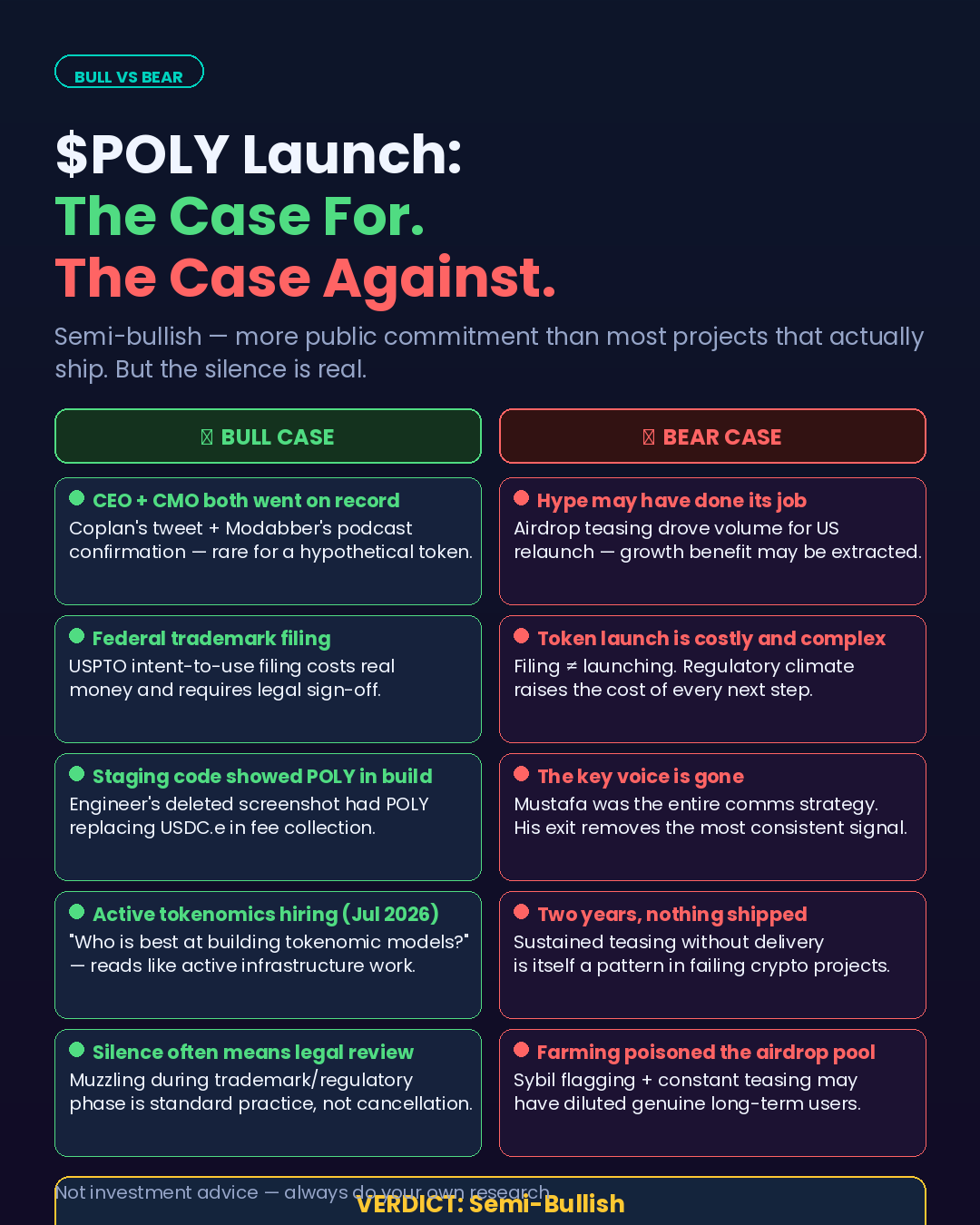
Taken together, I’d call the case for $POLY semi-bullish rather than either a lock or a lost cause. The strongest argument in favor is simply how public and repeated the commitment was at the top of the company, a sitting CEO and a CMO both went on record, and a real trademark filing followed months later, showing the legal groundwork was actually being laid rather than just talked about. It would be a mistake to assume the project quietly died just because the public teasing cooled off for a few months; large token launches routinely go quiet during the exact phase where the real legal and technical work happens.
The strongest argument against launching is more structural: if the actual goal is simply rewarding a loyal community, you don’t need to tease an airdrop constantly for two years. Doing so is arguably counterproductive, since aggressive, repeated teasing is precisely what attracts short-term farmers who dilute allocation meant for genuine long-term users. There’s a real possibility Polymarket already extracted most of the growth benefit it wanted from the hype cycle itself, and that the incentive to actually follow through with a costly, legally complex token launch has diminished as a result, particularly with the engineer who’d become the face of the teasing no longer at the company.
Either way, the paper trail here is unusually rich for a crypto project that still hasn’t launched anything. Between a CEO’s post, a CMO’s on-record podcast confirmation, a federal trademark filing, and two years of engineer-level breadcrumbs, Polymarket has left behind more public commitment to $POLY than most projects that actually ship tokens. What happens next likely depends less on community sentiment and more on decisions being made well outside of public platforms, in whatever room Polymarket’s legal team is currently occupying.
Disclosure: This is not trading or investment advice. Always do your research before buying any cryptocurrency or investing in any services.
Follow us on Twitter @themerklehash to stay updated with the latest Crypto, NFT, AI, Cybersecurity, and Metaverse news!