

Six weeks ago, Robinhood Chain didn’t have a stablecoin ecosystem worth mentioning. Now it has three competing for dominance, and the combined total has blown past $650 million, a scale most Layer 2 networks take years to reach, not weeks.
What’s happening here isn’t just a number going up, it’s a genuine three-way contest over which kind of dollar wins on a brokerage-built blockchain, and the answer says a lot about where retail crypto liquidity is actually heading.
The $650 Million Number, And Where It Came From
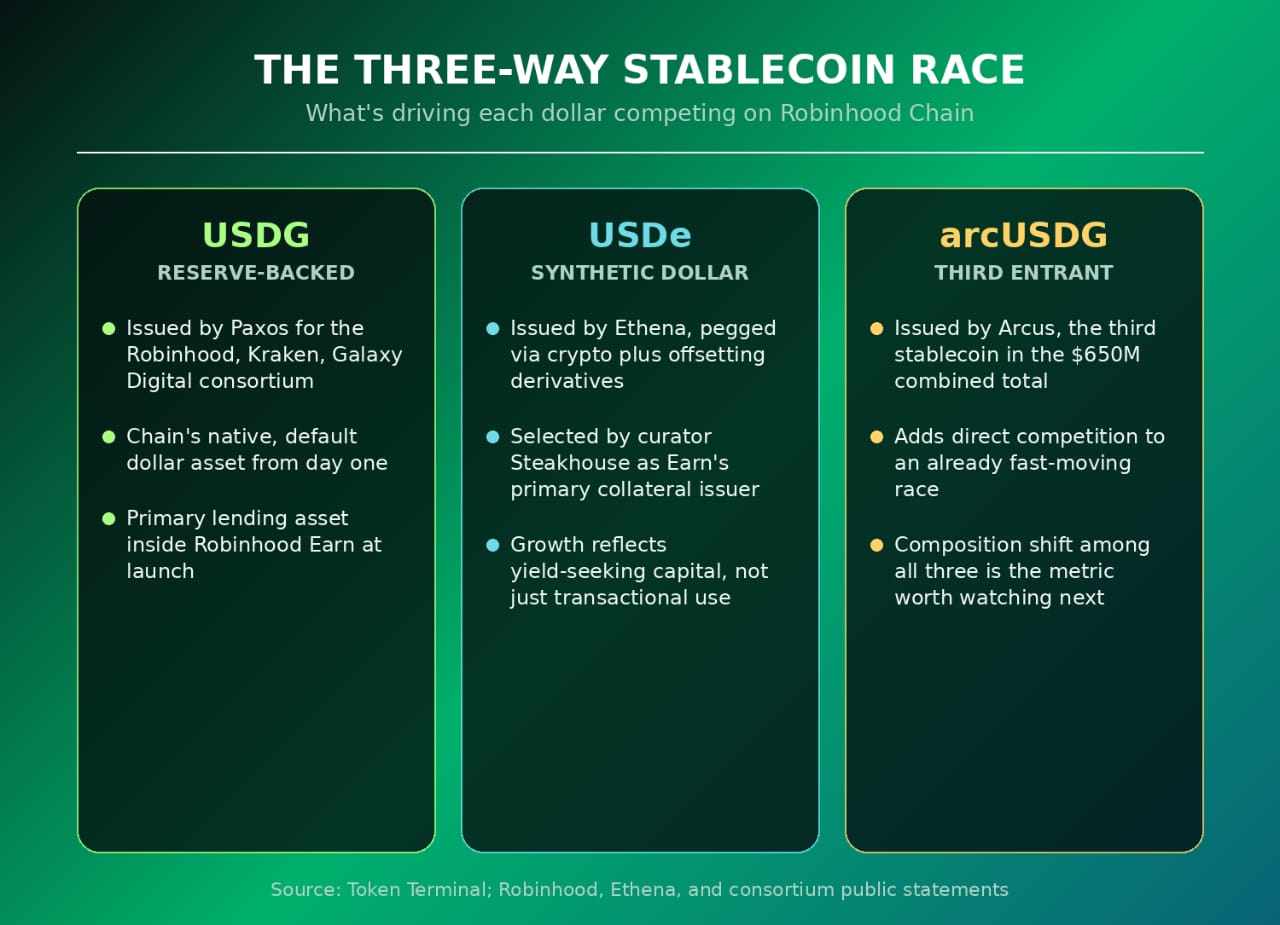
According to on-chain analytics platform Token Terminal, Paxos’ USDG, Ethena’s USDe, and Arcus’ arcUSDG have collectively grown to more than $650 million in combined market cap on Robinhood Chain in just a few weeks.

I think the pace here is what makes this genuinely newsworthy rather than routine. Robinhood Chain’s public mainnet only went live on July 1, 2026, meaning this entire stablecoin ecosystem has been built from zero to over half a billion dollars inside roughly six weeks, on a chain that didn’t exist in its current form before this summer.
How Robinhood Chain Actually Launched
To understand why stablecoins found their way onto this chain so quickly, you need the full launch story, and Robinhood laid it out directly in its own official announcement. The company confirmed it officially launched the public mainnet of Robinhood Chain, describing it as a Layer 2 blockchain built using the Arbitrum Platform to institutional standards and natively connected to Robinhood’s onchain users, serving as a turnkey environment for builders.
Central to that launch was Robinhood Earn, the company’s first decentralized lending product available directly through the main Robinhood app, letting users lend their dollar-backed USDG through a self-custody wallet at an estimated 7% annual percentage yield, with insurance procured through Lloyd’s of London and RELM covering losses from cyber or smart contract exploits. Robinhood confirmed the underlying lending infrastructure runs on the Morpho protocol, built with the support of partners including Steakhouse, Ethena, Spark, and Maple. That single product decision, tying a headline 7% yield directly to a stablecoin deposit, is effectively what set this entire growth race in motion.
Why USDG Had The Home-Field Advantage
USDG’s early dominance wasn’t an accident of timing, it was baked into the chain’s design from the start. Robinhood, alongside Kraken, Galaxy Digital, and Paxos, originally formed the consortium behind USDG back in November, with Paxos issuing the stablecoin specifically to accelerate global stablecoin adoption through what the firm described as a more equitable reserve revenue-sharing model. Kraken co-CEO Arjun Sethi said at the time that USDG was designed to bring mainstream participants into the stablecoin ecosystem by addressing what he called a lack of real competition in the regulated stablecoin market. That founding partnership gave USDG a structural head start as Robinhood Chain’s native, default dollar asset once the mainnet actually launched.
I think that early advantage explains why USDG initially captured the overwhelming majority of stablecoin activity on the chain, functioning as the primary lending asset inside Robinhood Earn from day one and giving it a natural distribution channel that competing stablecoins simply didn’t have built in.
Ethena’s USDe Mounts A Genuine Challenge
What’s genuinely interesting about the current $650 million figure is that it’s no longer a one-horse race. Ethena’s synthetic dollar, USDe, has grown aggressively enough to meaningfully close the gap with USDG, driven largely by its role as the primary yield-generating collateral asset within Robinhood Earn itself. Ethena was specifically selected by Steakhouse, the curator managing the Earn vault, to serve as the primary collateral issuer for Robinhood’s first crypto earn product, giving USDe a direct, structural pathway into the same yield product originally built around USDG.
I think this is the part of the story worth watching most closely going forward. USDe isn’t a traditional, fiat-collateralized stablecoin, it maintains its dollar peg synthetically through crypto assets paired with offsetting derivatives positions, meaning its rapid growth on Robinhood Chain reflects yield-seeking capital deliberately choosing a synthetic dollar over a conventional reserve-backed one. That’s a meaningfully different kind of demand than simple transactional stablecoin usage, and it suggests a real portion of the capital arriving on Robinhood Chain is specifically chasing yield rather than just parking dollars to trade.
What This Growth Says About Robinhood’s Broader Chain Strategy
Stepping back, I think the stablecoin race unfolding on Robinhood Chain reflects something bigger than any single token’s growth curve. Robinhood built this chain specifically to connect its existing 28 million-customer brokerage base directly to onchain finance, and its own launch materials describe the network as designed to be AI-native and tailored specifically toward real-world assets, integrated from day one with infrastructure partners including Alchemy, BitGo, and Chainlink to provide ready-made DeFi capabilities like lending and borrowing.

A rapidly growing, competitive stablecoin base sitting at the center of that infrastructure is exactly the kind of foundation Robinhood needs if it wants Robinhood Chain to function as genuine financial rails rather than just a novelty blockchain attached to a brokerage app. Whether USDG, USDe, or Arcus’ arcUSDG ultimately ends up dominating that base long-term matters less than the underlying signal all three are sending together: real, meaningful dollar liquidity is choosing to settle on this chain at a pace that’s genuinely rare for a network barely six weeks into its public life.
What Comes Next For The Three Stablecoins
For anyone tracking this space going forward, I think the real metric to watch isn’t the combined $650 million total itself, it’s how the composition between the three assets continues to shift. A chain where yield-bearing synthetic dollars like USDe keep gaining share against a reserve-backed stablecoin like USDG tells a different story about user intent than one where a single stablecoin holds a stable, dominant position.
Robinhood’s own Earn product sits directly at the center of that dynamic, since it’s the mechanism actively pulling capital toward whichever stablecoin currently offers the most attractive yield pathway. As Robinhood Chain continues maturing past its initial six-week launch window, this three-way stablecoin contest is likely to remain one of the clearest, most concrete signals of whether the broader Robinhood Chain experiment is translating into genuine, sustained onchain financial activity, or simply an early rush of yield-chasing capital that could rotate elsewhere just as quickly as it arrived.
Disclosure: This is not trading or investment advice. Always do your research before buying any cryptocurrency or investing in any services.
Follow us on Twitter @themerklehash to stay updated with the latest Crypto, NFT, AI, Cybersecurity, and Metaverse news!