
I’ll admit my first reaction to seeing “new blockchain gets a block explorer” was to scroll right past it.
That’s usually filler news, the kind of infrastructure update nobody outside a small circle of developers actually cares about. But the more I sat with the timing of Arc’s launch and Etherscan’s response to it, the more I became convinced this specific detail is doing a lot more work than it appears to on the surface. Most new chains spend their first few weeks scrambling to explain themselves. Arc spent its first day being explainable.
A Detail Most People Are Scrolling Past
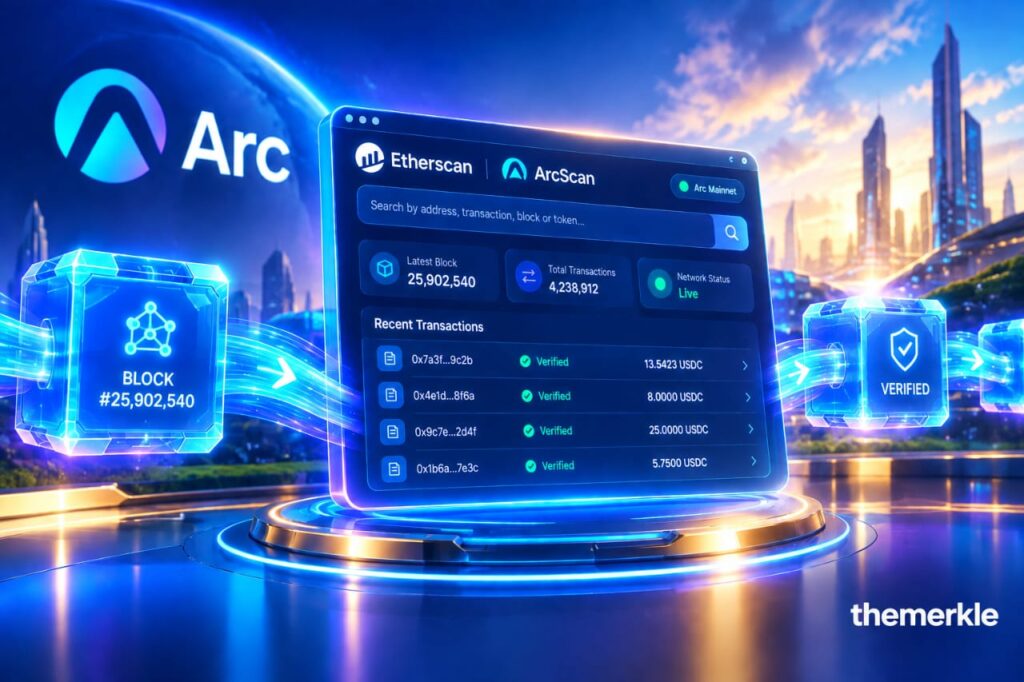
Here’s what actually happened, stripped of the hype. Circle’s new Arc blockchain went live to the public on September 16, 2026, and within that same window, Etherscan confirmed that it had built and launched ArcScan, a dedicated explorer for the chain, live at arc.etherscan.io.
On its own, that headline reads like routine infrastructure news.

But I think the reason it deserves more attention than it’s getting is that this kind of same-day pairing almost never happens. Most chains launch first and figure out their explorer situation later, sometimes weeks or months later, often through a patchwork of unofficial tools before anything official arrives.
What Actually Went Live On September 16
Arc isn’t just another speculative Layer 1 chasing attention, it’s Circle’s own chain, built specifically around paying gas fees in USDC rather than a native token, with real infrastructure already deployed on it, including Uniswap v4. That’s a chain being positioned as payment rails, not a casino. And I think that context matters enormously for why the explorer timing stands out. A chain built for actual payment volume needs to be auditable from minute one, because the entire pitch depends on transactions being verifiable, not just promised. Launching ArcScan simultaneously with mainnet rather than as an afterthought tells me Circle and Etherscan both understood that trust infrastructure isn’t a nice-to-have for a payments chain, it’s the product.
The Explorer Problem Most New Chains Never Solve
I’ve watched enough chain launches to know what the alternative looks like, and it isn’t pretty. Without an official, trusted explorer ready on day one, users are left guessing whether a contract address is legitimate, whether a transaction actually cleared, or whether the token they’re looking at is the real one and not an impersonator. That gap tends to get filled by unofficial tools of wildly varying quality, and by the time an official explorer finally shows up, a chain’s ecosystem is often already cluttered with confusion that takes months to clean up. Arc skipped that entire phase.
Having Etherscan’s name behind the explorer specifically matters here too, because Etherscan isn’t some unproven newcomer, it’s the same infrastructure that’s become the default trust layer for Ethereum itself, and extending that reputation to Arc on day one is a credibility transfer that a brand-new, unknown explorer simply couldn’t offer.
A Free Window That Reveals How Etherscan Is Managing Arc’s Growth
A few days after the launch, Etherscan followed up with something I think reveals even more about how deliberately this rollout is being managed. It opened a free priority support window for developers submitting token info updates on ArcScan, running through September 30, 2026.
That’s not a small courtesy, it’s a direct response to a problem every new chain faces, which is a flood of projects all trying to get their tokens properly labeled and verified at once. Left unmanaged, that flood usually leaves an explorer cluttered with unverified, mislabeled, or outright fake token entries for months. Giving developers a fast, no-cost path to get it sorted in Arc’s first few weeks is a proactive move to keep the ecosystem’s data clean before the clutter has a chance to accumulate.
The Guardrails Buried In The Fine Print
What convinced me this wasn’t just a marketing gesture were the conditions Etherscan attached to it. Submissions remain subject to project review and eligibility, priority processing speeds up the queue without guaranteeing verification, ranking, or approval, and every label and piece of metadata submitted must be factually accurate. I think that last requirement is the real tell.
A lot of token scams succeed specifically by getting misleading names or labels past an explorer’s review process, so drawing a hard line on accuracy even while fast-tracking legitimate developers is exactly the kind of guardrail that keeps a young ecosystem’s data trustworthy rather than just fast. Speed without that discipline would have made the free window a liability instead of an asset.
What This Early Signal Says About Arc’s Real Ambitions
I keep coming back to the same conclusion: the sequence here, mainnet launch, trusted explorer live almost simultaneously, then a structured, accuracy-gated process for developers to get properly documented, isn’t how chains behave when they’re rushing to capture attention before the excitement fades. It’s how chains behave when they’re building for the long term and expect to be scrutinized.
Arc is explicitly positioning itself around real payment infrastructure rather than speculation, and a chain making that claim has to be more auditable than the average speculative L1, not less. Etherscan building ArcScan on day one, rather than weeks after the fact, is a small operational detail that quietly signals something bigger about how seriously both companies expect Arc to be used. I think that’s exactly why it’s worth more attention than a routine explorer launch usually gets.
Disclosure: This is not trading or investment advice. Always do your research before buying any cryptocurrency or investing in any services.
Follow us on Twitter @themerklehash to stay updated with the latest Crypto, NFT, AI, Cybersecurity, and Metaverse news!