

I checked Ethereum’s live gas tracker while researching this piece, and the number staring back at me was almost comical: 0.074 gwei. At that rate, moving ETH across the network costs a fraction of a cent.
Then I looked at what several major exchanges actually charge users to withdraw that same asset, and the gap between those two numbers is the entire story. It’s not a glitch, and it’s not exchanges simply passing along blockchain costs. It’s a pricing model built on a detail most users never think about: batching.
What On-Chain Gas Actually Costs Right Now
Let’s start with verified ground truth, since everything else in this article depends on it. According to Etherscan’s own live gas tracker, Ethereum’s network gas price sat at 0.074 gwei this week, with the low, average, and high readings all clustered tightly together, meaning this wasn’t a lucky snapshot during an unusually quiet moment. Independent trackers confirm the same range, with one live gas tool pricing a standard 21,000-gas transfer at roughly $0.007, and broader industry data describing daily average gas on Ethereum mainnet sitting below 1 gwei as the norm throughout 2026, a direct result of the network’s Pectra efficiency upgrades and the blob-based scaling introduced by EIP-4844.
Running the actual math confirms it. A basic 21,000-gas ETH transfer at 0.074 gwei costs approximately 0.0000015 ETH, which at Ethereum’s current price of roughly $2,400 works out to about $0.0037, well under half a cent. Even a heavier transaction, the kind an exchange’s hot wallet infrastructure might realistically execute, using something closer to 65,000 gas, comes out to roughly $0.012. So the honest, verified range for what Ethereum’s network actually charges for a typical withdrawal-style transaction sits somewhere between $0.004 and $0.015. Etherscan’s own knowledge base walks through exactly how that calculation works, and it’s worth reading directly here if you want to verify it yourself rather than take any exchange’s word for it.
What Exchanges Actually Charge For The Same Transaction
Now compare that verified range against what a real exchange charges. Binance’s own current withdrawal screen, used here purely as one representative example among many exchanges that follow a similar structure, shows an ERC20 ETH withdrawal fee of 0.00007 ETH, roughly $0.171 at current prices, a figure that lines up with the exchange’s own published official crypto fee schedule. Set that $0.171 fee against the verified mainnet cost of $0.004 to $0.015, and the markup lands somewhere between roughly 11 and 40 times the actual network cost.
That’s a meaningful gap, but I want to be precise about what it does and doesn’t prove on its own. A single flat fee sitting well above raw network cost isn’t automatically evidence of bad faith. Running exchange infrastructure costs real money: security audits, cold storage management, compliance staff, and insurance against the kind of large-scale hacks the industry has repeatedly suffered all have to be funded somehow. The real story isn’t that a markup exists. It’s how that markup scales once you understand what’s actually happening behind the scenes when thousands of people withdraw the same asset around the same time.
The Batching Mechanism Nobody Explains To Users
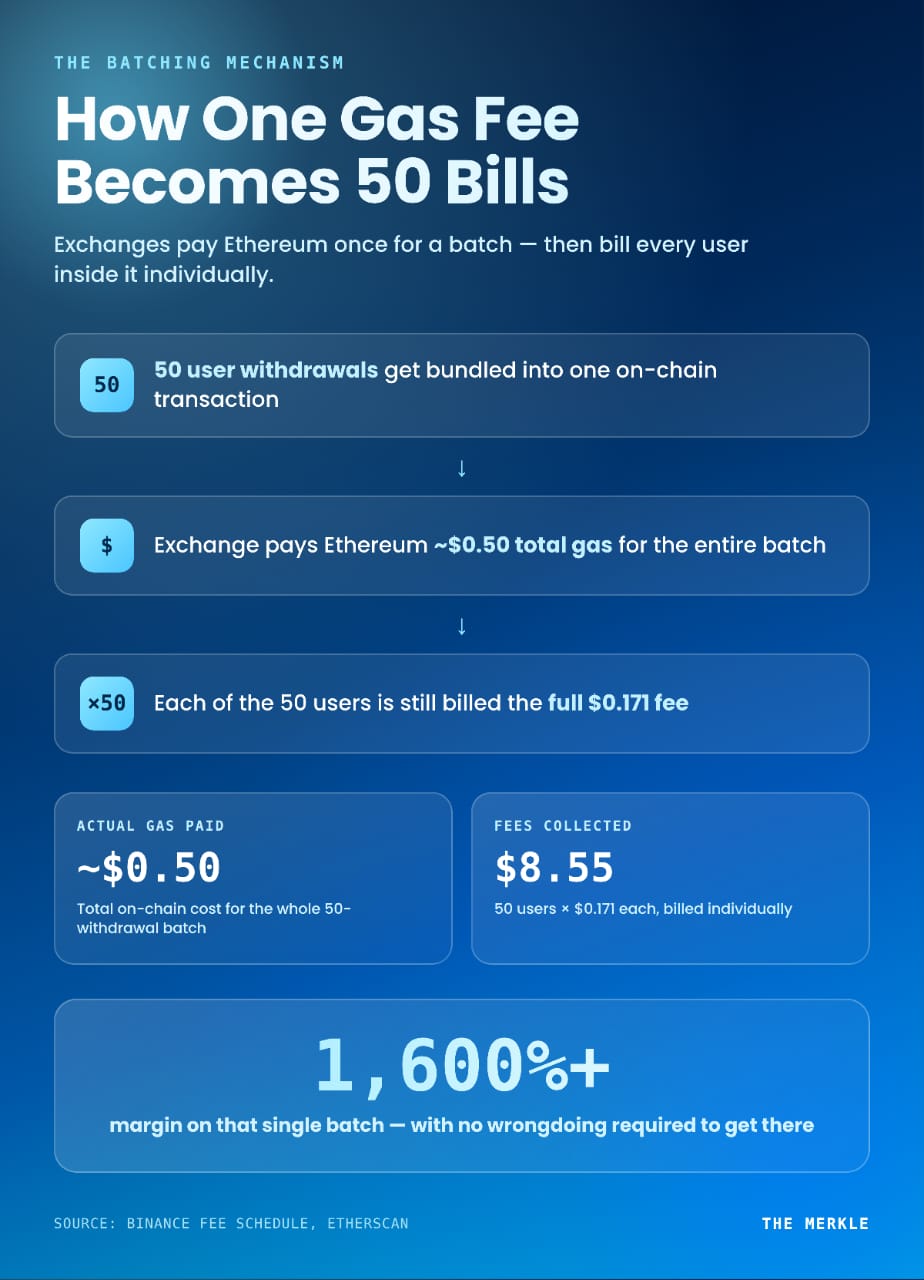
Here’s the part of this story that I think gets glossed over the most. When you withdraw crypto from a centralized exchange, your transaction is rarely processed as the single, isolated transfer most users picture in their head. Exchanges commonly batch multiple user withdrawals together into consolidated on-chain transactions, or route them through hot wallet infrastructure specifically optimized to minimize the total gas paid across a large volume of requests. A single batched transaction covering dozens of individual withdrawals still pays Ethereum’s gas fee once, or close to it, while every user swept into that batch is billed the full, individual withdrawal fee on their own end.
This is where the real economics of the markup live. If an exchange batches 50 withdrawals into a transaction that costs, say, $0.50 in total gas, and each of those 50 users is charged $0.171 individually, the exchange collects $8.55 in withdrawal fees against roughly $0.50 in actual network cost, a margin north of 1,600% on that batch alone. None of this requires any wrongdoing or deception in a legal sense. It simply means the flat fee model most exchanges rely on was never really designed to track the real-time cost of the underlying transaction. It was designed to be predictable, easy to communicate, and comfortably profitable across a wide range of network conditions.

What Dynamic Pricing Reveals About The Alternative
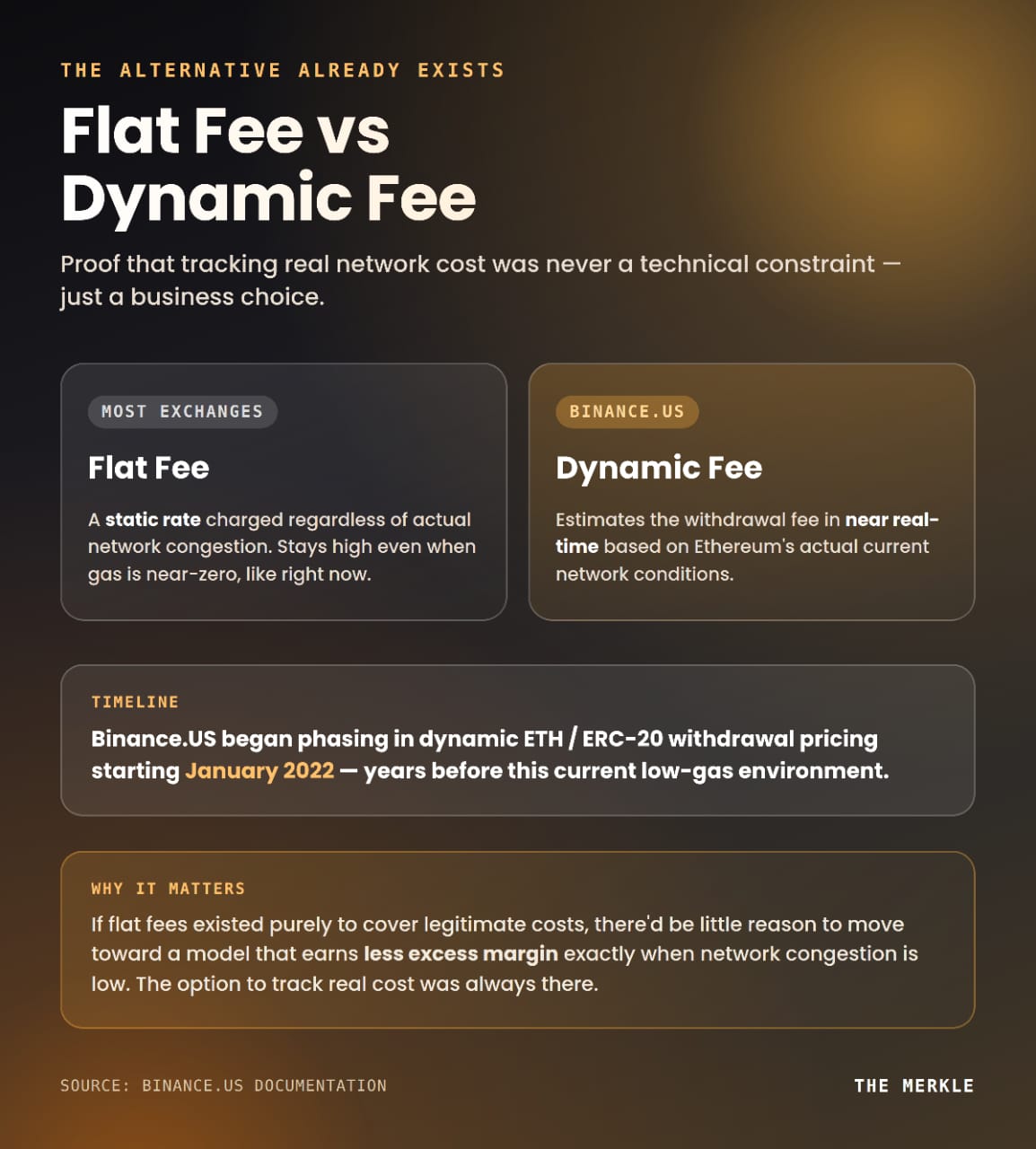
The clearest evidence that flat fees aren’t a technical necessity comes from exchanges that have moved away from them entirely. Binance.US shifted its ETH and ERC-20 withdrawal fees to a dynamic model, rolled out in phases starting in January 2022, specifically designed to estimate fees in near real-time based on Ethereum’s actual current network conditions rather than charging a static rate regardless of congestion. The exchange’s own documentation confirms this shift directly, explaining that a withdrawal fee is separate from, and paid in addition to, the underlying network fee itself.
That distinction matters because it demonstrates the alternative was always available. If flat withdrawal fees existed purely to cover legitimate infrastructure costs, there would be little commercial reason to move toward a pricing model that tracks much closer to real expenses and therefore generates less excess margin during periods of low network congestion, exactly the environment gas trackers show we’re in right now. The fact that dynamic pricing exists, and functions, suggests the flat-fee model most of the industry still defaults to is a business choice rather than an engineering constraint.

What This Means For Anyone Withdrawing Crypto
If there’s a practical lesson in all of this, it’s that a withdrawal fee tells you almost nothing about what your specific transaction actually costs the network at that moment. Checking a live gas tracker before withdrawing won’t change a flat fee an exchange charges, but it gives you the information needed to judge how much of that fee is genuine cost recovery versus built-in margin, which is useful whether you’re timing a withdrawal or simply choosing between platforms with different fee structures for the same asset.
The broader pattern here isn’t really a scandal so much as an open secret that most users never have a practical reason to investigate. Batching genuinely reduces what exchanges pay in aggregate gas costs, flat fees rarely move at the same pace as real gas prices do, and periodic fee reductions get framed publicly as customer-friendly gestures rather than acknowledgments of how much margin still exists between what users pay and what the blockchain itself actually demands. Understanding that gap doesn’t require assuming bad intent across the industry. It just requires checking the math, which, it turns out, takes about as long as opening a gas tracker in a second tab.
Disclosure: This is not trading or investment advice. Always do your research before buying any cryptocurrency or investing in any services.
Follow us on Twitter @themerklehash to stay updated with the latest Crypto, NFT, AI, Cybersecurity, and Metaverse news!