

I used to think of “falling for a scam” as something that happened to other people, the unwary, the unfamiliar, the digitally naive.
Then I started digging into who actually loses money to deepfake crypto livestreams, and that assumption fell apart fast. Engineers. Finance professionals. People who could explain blockchain mechanics in their sleep.
The uncomfortable truth is that these scams aren’t built to fool people who don’t understand crypto. They’re built to exploit the exact moment when even a smart, cautious person’s guard drops and once you see how deliberately that moment is engineered, it stops looking like a technology problem and starts looking like a psychology problem wearing a very convincing digital mask.
The Anatomy Of A Livestream That Fooled Thousands
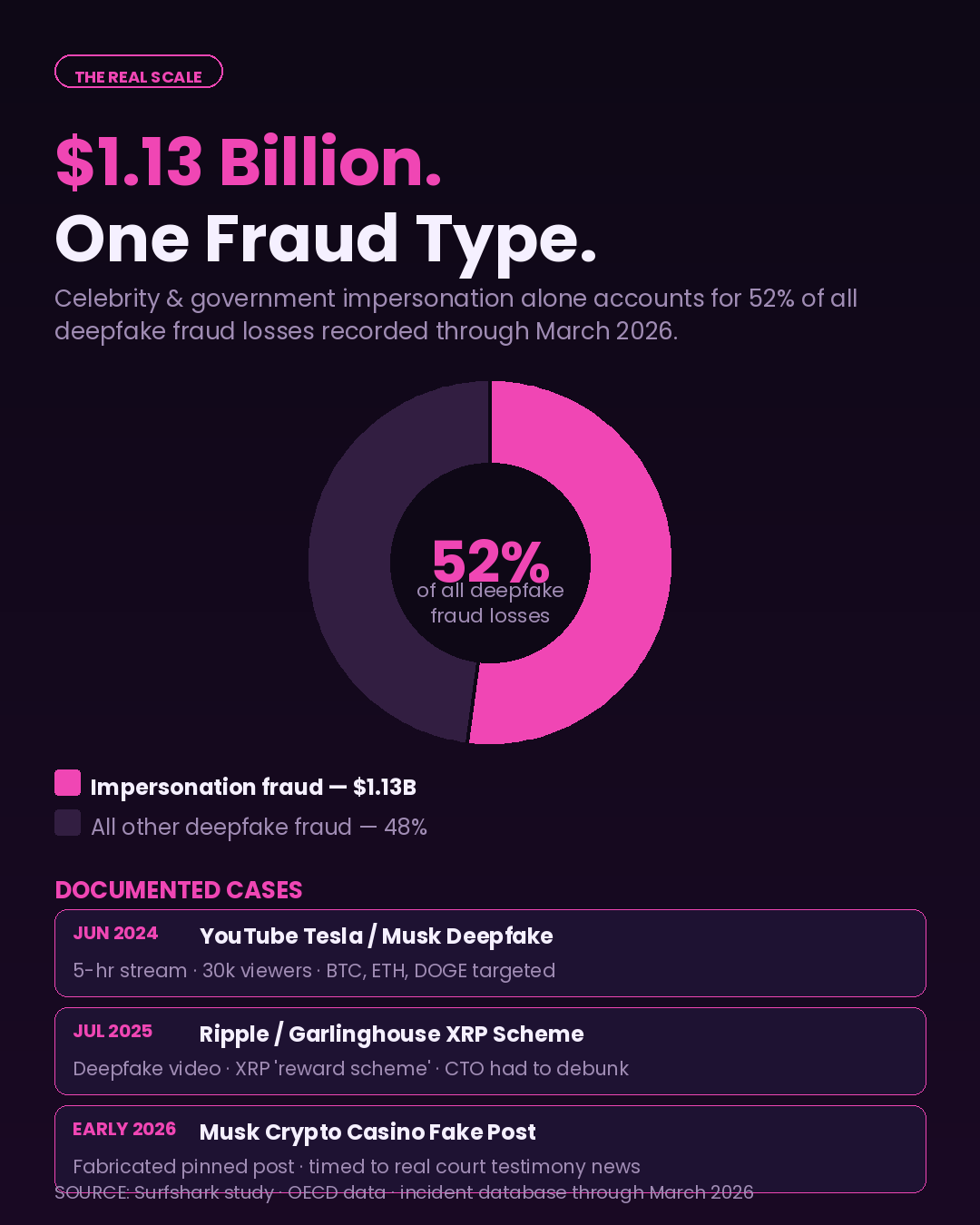
The clearest case study remains one from June 2024, and it’s aged into something close to a textbook example. A YouTube channel posing as an official Tesla account ran a five-hour livestream built entirely around a deepfake of Elon Musk. The AI-generated voice, looping over old event footage, instructed viewers to send Bitcoin, Ethereum, or Dogecoin to a displayed wallet address in exchange for double the amount sent back. At its peak, the stream pulled in roughly 30,000 simultaneous viewers, enough to land it in YouTube’s “Live Now” recommendations.
What makes this case worth returning to isn’t the technology, deepfake tools have only gotten sharper since. It’s the staging. The scammers didn’t invent a random moment to strike; they timed the stream, borrowed a hijacked, previously legitimate channel to inherit its subscriber trust, and let a bot-inflated viewer count do the rest of the persuading.
It Isn’t Just Musk, And It Isn’t Slowing Down
If this were an isolated Musk problem, it would be easier to dismiss as a one-off exploiting one man’s unusually public profile. It isn’t. In July 2025, a deepfake video circulated showing Ripple CEO Brad Garlinghouse endorsing an XRP “reward scheme,” convincing enough that Ripple’s own Chief Technology Officer had to step in and publicly debunk it. The pattern repeated again in early 2026, when scammers fabricated a fake “pinned post” from Musk promoting a crypto casino giveaway, timed deliberately to ride the news cycle following his real, unrelated court testimony about cryptocurrency.
The throughline across every one of these cases is the same: pick a face the public already trusts, attach it to a real, current event, and let borrowed credibility do the persuading that the scam itself could never do on its own merits.
The Real Number Behind The Headlines
It’s worth pausing on scale, because these incidents aren’t scattered curiosities, they’re a dominant category of fraud. A Surfshark study drawing on incident-database and OECD data through March 2026 found that celebrity and government impersonation now accounts for roughly $1.13 billion in deepfake-related losses, close to 52% of all deepfake fraud recorded. That single statistic reframes the whole issue: this isn’t a fringe internet nuisance. It’s the single largest slice of an entire fraud category, built almost entirely on borrowed faces and borrowed trust.

The Psychological Levers Doing The Actual Work
Here’s where I think the “how are smart people falling for this” question gets its real answer, and it has almost nothing to do with how convincing the video pixels look. These scams are engineered around a small set of well-documented psychological pressure points, stacked deliberately on top of each other.
Authority is the first lever, a recognizable, trusted face short-circuits the skepticism people would normally apply to a stranger’s promise. Social proof is the second, a viewer counter showing tens of thousands of concurrent watchers, even artificially inflated by bots, signals “other people are already doing this,” which quietly lowers individual caution. Scarcity and urgency form the third and most aggressive lever: language like “you can only participate once” or a countdown-style framing pushes people to act before the analytical, skeptical part of their brain has time to catch up with the emotional, excited part. And finally, there’s the sheer arithmetic seduction of “send one, get two back”, a promise so simple it bypasses the more complex reasoning people would normally apply to an investment decision.
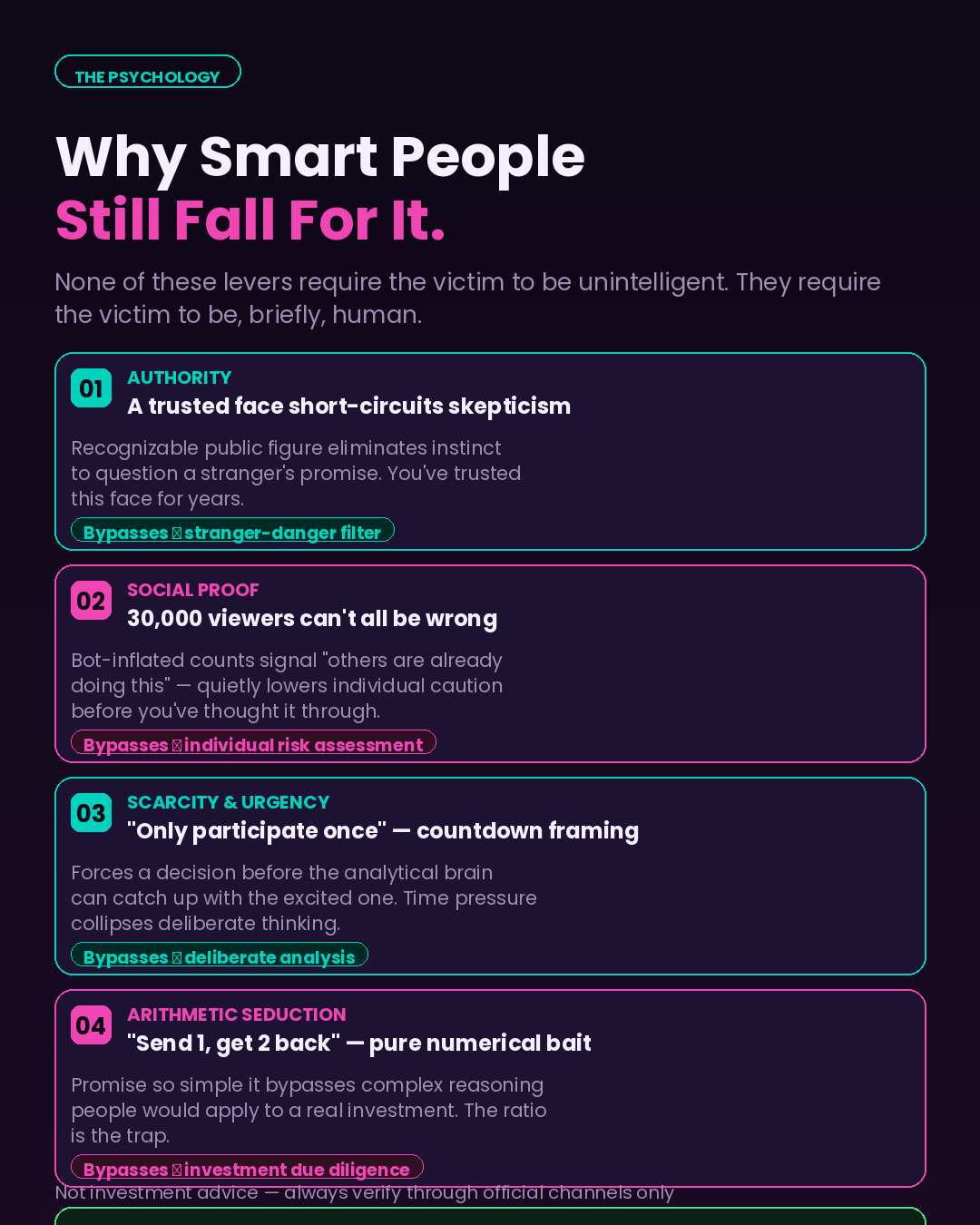
None of these levers requires the viewer to be unintelligent. They require the viewer to be, briefly, human, excited, time-pressured, and pattern-matching against a face they’ve trusted for years.
What Actually Breaks The Spell
The one consistent defense across every documented case is startlingly simple, and it has nothing to do with spotting visual glitches in the deepfake itself, which are often too subtle to catch in real time anyway. It’s the arithmetic check: no legitimate entity, celebrity or otherwise, sends back more cryptocurrency than it receives, ever, under any circumstance. The moment a “giveaway” promises to double your money for simply sending it first, the specific face on screen becomes irrelevant, the offer itself is the tell, not the video quality. Verifying claims only through a company’s or individual’s official, established channels, rather than a livestream link or a viral clip, remains the single most reliable filter against a scam category that’s only going to get harder to visually detect as the underlying AI tools keep improving.
Disclosure: This is not trading or investment advice. Always do your research before buying any cryptocurrency or investing in any services.
Follow us on Twitter @themerklehash to stay updated with the latest Crypto, NFT, AI, Cybersecurity, and Metaverse news!