
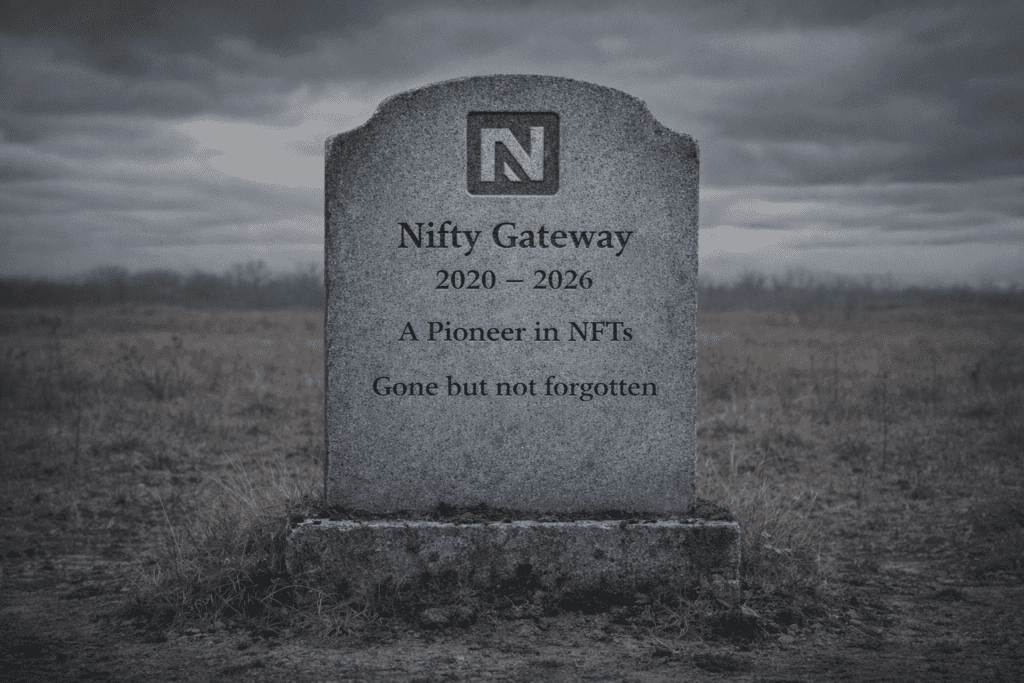
The NFT community is bidding a heavy-hearted farewell to Nifty Gateway, one of the pioneering platforms of the digital art revolution. In an official statement, the team announced that Nifty Gateway will shut down on February 23, 2026, and as of today (January 24, 2026) the platform has entered a withdrawal-only mode. For artists, collectors, and enthusiasts who rode the NFT wave on Nifty Gateway, this news feels like the end of an era – one filled with groundbreaking art, frenzied drops, and a transformative cultural movement. Yet amid the sadness and nostalgia, there’s a flicker of optimism: the end of Nifty Gateway is not the end of digital art or ownership, but rather the close of one influential chapter as a new one begins.
From Vision to Vanguard: The Rise of Nifty Gateway
Launched in 2020 by twin brothers Duncan and Griffin Cock Foster, Nifty Gateway was born of a bold vision to “revolutionize digital art”. Backed by an early acquisition from crypto exchange Gemini in late 2019, the Cock Foster brothers set out to create a platform where artists and collectors could engage with NFTs effortlessly. At its inception, Nifty Gateway offered something extraordinarily different – a “canvas for innovation” where curious artists could experiment with blockchain technology without friction. High-quality creators flocked to the platform, contributing stunning yet accessible pieces that collectors could acquire without wading through the complexities of crypto wallets or exorbitant prices. This inclusive approach – including credit card support and custodial wallet options – helped lower barriers for newcomers and positioned Nifty Gateway at the forefront of a nascent movement.
Under Duncan and Griffin’s leadership, the platform quickly grew into a premier destination for digital art. By empowering artists worldwide, Nifty Gateway facilitated an unprecedented creative economy – paying out over $500 million to artists across the globe. Many of these creators hailed from far-flung places and had been overlooked by the traditional art world, until Nifty Gateway connected them with a global audience. This massive payout figure stands as a testament to the marketplace’s impact: during its peak years, Nifty Gateway quite literally changed artists’ lives, funneling hundreds of millions of dollars to digital creators and helping to prove that art on the blockchain could be both culturally significant and financially rewarding.
The 2021 NFT Boom: Nifty Gateway’s “Nifty Summer”
If the platform’s early days were a quiet genesis, 2021 was an explosion – a period the community nostalgically calls the “Nifty Summer.” During this NFT boom, Nifty Gateway became synonymous with the frenzy and euphoria of the new digital art gold rush. Top artists like Beeple, XCOPY, and Trevor Jones saw their work skyrocket in value and notoriety. It was on Nifty Gateway that some of the most iconic moments of the NFT craze unfolded.
Beeple’s “CROSSROAD” NFT – part of his first Nifty Gateway drop – was resold on the platform in February 2021 for a record-breaking $6.6 million, capturing global attention. This 10-second video artwork, which changed based on the U.S. election outcome, became one of the most expensive and talked-about NFT sales in history.
The CROSSROAD sale was just one headline in a streak of astonishing events. Only months earlier, in December 2020, Beeple had debut drops on Nifty Gateway that generated $582,000 in minutes (and $2.2 million in days), signaling the tidal wave to come. Soon after, musicians and celebrities joined the fray. In early 2021, musician Grimes sold her “WarNymph” NFT collection on Nifty Gateway for around $6 million in 20 minutes, outpacing her earnings from some traditional music releases. Other mainstream figures – from NFL stars to globally renowned artists – chose Nifty Gateway for their NFT debuts, bringing an unprecedented spotlight to the platform and NFTs at large.
The frenzy of Nifty Gateway’s curated drops often felt like a cultural event. Thousands of collectors would flood the site during timed releases, eagerly counting down to snag limited editions or one-of-a-kind “nifties.” Open edition drops (where unlimited copies could be minted in a short window) became a popular innovation, with pieces selling by the hundreds or thousands and generating millions in minutes. The platform’s servers were strained by traffic during major drops, a sign of just how many new enthusiasts Nifty Gateway had onboarded into the world of NFTs. Indeed, NFTs went from niche crypto novelty to bona fide cultural mainstay in 2021, and Nifty Gateway was at the heart of that transformation.
Yet amid the parabolic growth and party atmosphere, challenges loomed. The rapid success attracted speculators alongside passionate art collectors. By late 2021, the broader NFT market had grown frothy, and Nifty Gateway’s open-arms approach was tested by oversaturation and hype. Some critics pointed out that as the frenzy peaked, “virtually anyone could mint anything,” making it harder to separate meaningful art from opportunistic cash grabs. Nifty Gateway, once a tightly curated bazaar, saw an influx of projects – some brilliant, others less so – reflecting the “craze and haze” of the times. Even as record-breaking sales like Pak’s “The Merge” in December 2021 amassed $91.8 million from 28,000 buyers on Nifty Gateway, it was clear that the market was racing ahead at breakneck speed, and a cooldown was inevitable.
Innovation, Community, and Cultural Impact
Throughout its highs and lows, Nifty Gateway stood out for its innovations and the passionate community it fostered. Unlike decentralized, open marketplaces (e.g. OpenSea), Nifty Gateway was curated – each drop was hand-selected or in collaboration with artists, giving the platform a gallery-like aura. This curation helped maintain a level of quality and excitement; collectors knew that each “Nifty” drop was an event featuring notable creators or unique concepts. The platform experimented with novel drop mechanics – from open editions, to auctions, to drawings (lotteries) for the chance to buy limited pieces – many of which later became standard practice in the NFT space. Nifty Gateway also bridged the gap between crypto natives and newcomers by enabling credit card purchases and custodial accounts, meaning anyone could buy an NFT with dollars (no crypto experience required). This was a game-changer that brought in waves of new collectors and helped pioneer mainstream NFT adoption when it mattered most.
Crucially, Nifty Gateway provided real value to artists and creators in ways the traditional art market often could not. By tapping into a global pool of collectors 24/7, digital artists could earn income on a scale previously unheard of. Under the Cock Foster twins’ tenure, over $500 million was paid out to artists worldwide on the platform – an astonishing sum that validated NFTs as a viable new model for creative careers. Many artists from emerging markets or underrepresented communities suddenly found enthusiastic buyers on Nifty Gateway, whereas they might never have broken into elite auction houses or galleries. This democratization of opportunity is a huge part of Nifty Gateway’s cultural legacy. It wasn’t just about big names making big money; it was also about empowering a new generation of artists and giving collectors a chance to directly support creators they love.
The community spirit on Nifty Gateway was another key piece of its value. Collectors often describe the thrill of those early drop days – the camaraderie in chat rooms and social media as everyone waited for a release, the collective gasp when a piece sold out in seconds, the pride of sharing a newly acquired artwork with fellow enthusiasts. Nifty Gateway helped cultivate this sense of participation in a cultural movement. Art was no longer confined to museums or wealthy patrons; with NFTs, anyone with a few dollars and a passion could own a piece of a meme, a moment, or a masterpiece. This mainstreaming of digital art ownership – turning it into dinner-table conversation around the world – owes a lot to what Nifty Gateway and its peers achieved in those formative years.
The Long Winter and a Fond Farewell
After the dizzying highs of 2021, the NFT market settled into a quieter phase – an “NFT winter” – through 2022 and 2023. Trading volumes fell from their peaks, speculative frenzy died down, and many trend-chasers moved on. Nifty Gateway, like other platforms, had to adapt to a more mature market. The team doubled down on curation and quality over quantity, launching new initiatives (like the “Publishers” pilot in 2022 that enabled independent curators to run their own NFT storefronts) in an effort to rekindle interest and support artists in a sustainable way. During this period, the Cock Foster brothers – having stayed on for four years post-acquisition – stepped down from their leadership roles in early 2023, passing the torch to a new team. Their departure, while wistful, was amicable and true to their nature as entrepreneurs: “This journey has been an incredible ride,” Duncan wrote, “but we are founders at heart and want to start another company”. The founders left behind a vibrant platform and community, even as overall NFT hype cooled.
By 2025, parent company Gemini had shifted its strategic focus toward its core exchange and a broader “super app” vision. Nifty Gateway’s niche – albeit beloved – was no longer central to those plans amid declining user activity and a changing regulatory climate for NFTs. Thus came the difficult decision now upon us: to wind down Nifty Gateway and direct resources elsewhere. The official announcement of the shutdown struck a melancholic chord, in part because of the gratitude and hope expressed within it. “We are incredibly proud of the work the Nifty team has pioneered and grateful to Nifty Gateway’s customers and artists for joining us on this journey,” the team wrote in their farewell message. They affirmed that the decision allows Gemini to refocus, and promised to support NFTs in other ways (for example, through Gemini’s wallet services) even after the marketplace is gone.
For long-time users, the idea of Nifty Gateway “going dark” is undeniably bittersweet. There’s sadness, of course – nostalgia for the thrill of past drops and the sense of being part of something revolutionary. But there’s also a profound sense of pride in what was accomplished. Nifty Gateway proved that digital art could capture the world’s imagination. It helped onboard untold numbers of people to the concepts of provable digital ownership and the metaverse future that many believe still lies ahead. It pioneered mainstream NFT adoption, showing large institutions (from auction houses to tech giants) that a market for NFTs does exist when nurtured properly. And it leaves behind a legacy of innovation that future platforms can build upon.
The Legacy Lives On: Hope for the Future of Digital Art
As we reflect on Nifty Gateway’s journey – from its trailblazing start, through the wild heights of the NFT boom, to its graceful wind-down – it’s clear that its influence will far outlast its operational years. The broader vision that Nifty Gateway championed is alive and well: artists continue to tokenize their work, collectors continue to value digital ownership, and new platforms and communities keep emerging (often learning from Nifty’s successes and missteps). In many ways, Nifty Gateway’s story encapsulates the arc of the NFT space itself – a cycle of exuberant innovation, intense growth, introspection, and renewal.
It’s important to remember that technology and art are ever-evolving. Today’s closure is not a failure so much as a natural turning of the page. As the Cock Foster twins themselves noted upon leaving, the road to NFTs becoming a mainstream, everyday technology was “longer and more winding than we originally thought,” but they “always have believed that is where the industry is headed.” In other words, the destination hasn’t changed – only the timeline and the players. Nifty Gateway’s shutdown is a reminder that the NFT ecosystem is still young and adapting, weeding out what doesn’t work and doubling down on what does.
Looking forward, there’s plenty of reason for optimism. The concept of digital provenance for art – pioneered in the mainstream by platforms like Nifty – has taken root in the art world and is here to stay. Artists are more empowered than ever to create and sell work on their own terms. Collectors are becoming more discerning, focusing on meaningful art and utility rather than pure speculation, which will ultimately lead to a healthier market. And major cultural institutions (from art museums to music labels) are now experimenting with NFTs, something almost unthinkable before Nifty Gateway and its contemporaries proved the concept.
In a heartfelt sense, Nifty Gateway’s greatest achievement may have been inspiring a generation of artists and innovators. Its rise and fall taught us so much about what digital communities can achieve. Despite this setback, digital art continues to transform the world. New marketplaces, decentralized platforms, and even traditional auction houses will carry the torch forward, each in their own way. The closure of one beloved platform cannot extinguish the creative flame that it helped ignite in countless people.
So, as we say goodbye to Nifty Gateway, we do so with both sadness and gratitude. Sadness that such a vibrant marketplace is closing its doors – but gratitude (and even joy) for the memories it gave us, the art it fostered, and the new possibilities it revealed. The spirit of Nifty Gateway lives on in every NFT artwork and every artist and collector who dared to believe in the value of digital creations. In that sense, this is not truly a goodbye, but a passing of the baton. The legacy of Nifty Gateway will continue to shape the narrative of NFTs for years to come, as the world of digital art and ownership keeps evolving beyond this poignant finale.
TL;DR
-
Nifty Gateway, a pioneering NFT marketplace, is officially shutting down on Feb 23, 2026, after entering withdrawal-only mode on Jan 24, 2026. The news marks the end of an era for one of the NFT boom’s flagship platforms.
-
Founded by twin brothers Duncan and Griffin Cock Foster in 2019/2020, the platform helped ignite the 2021 NFT craze, hosting legendary drops from artists like Beeple, Pak, and Grimes. Nifty Gateway’s user-friendly, curated approach brought NFTs into the mainstream, even enabling credit-card purchases and attracting thousands of new collectors.
-
During its peak, Nifty Gateway paid out over $500 million to artists worldwide, empowering creators from all over the globe and demonstrating the game-changing potential of digital art markets. It facilitated record-breaking NFT sales (Beeple’s “CROSSROAD” resold for $6.6M, Pak’s “The Merge” garnered $91M+) and became synonymous with the explosive “Nifty Summer” of 2021.
-
The closure brings sadness and nostalgia, as the NFT community reflects on Nifty Gateway’s immense influence and the vibrant moments it created. Under the Cock Fosters’ leadership, the platform not only innovated with new drop formats and custodial wallets, but also proved that digital ownership and art could capture global imagination.
-
Despite this bittersweet shutdown, hope prevails for the future of NFTs and digital art. Nifty Gateway’s legacy – pioneering mainstream NFT adoption and uniting artists and collectors – will live on. The NFT ecosystem continues to mature, and the core idea of empowering artists through blockchain remains strong. This farewell is the end of one important chapter, but the story of digital art is far from over, with new platforms and creators carrying the vision forward.