

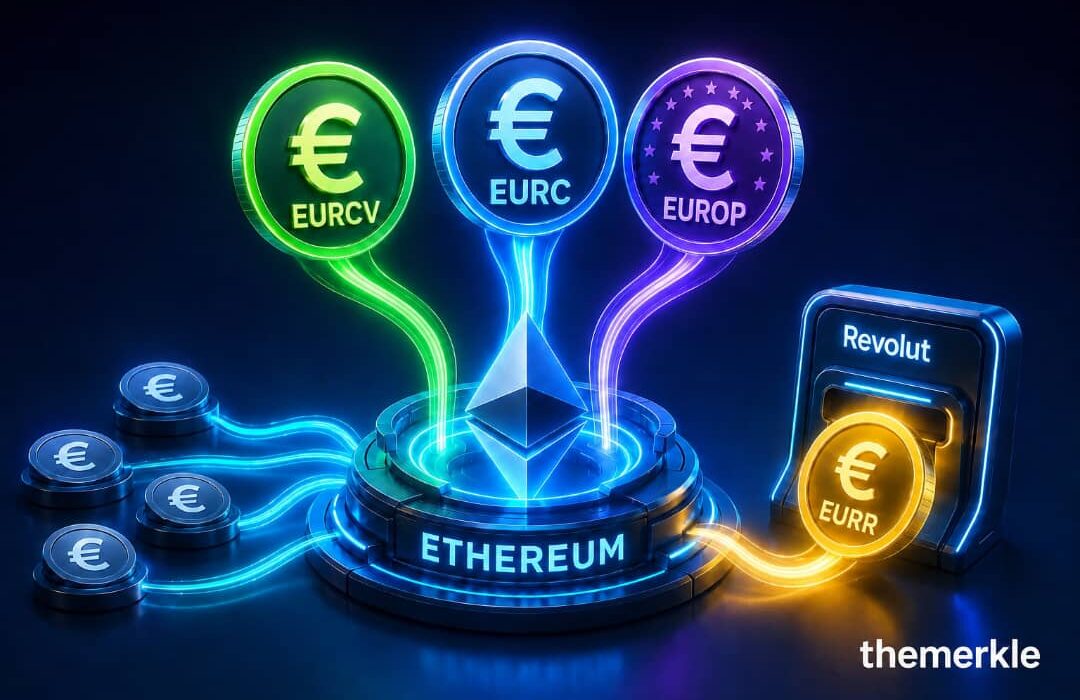
I keep coming back to the euro stablecoin sector because it’s one of the few corners of crypto where the numbers are still small enough to read like a story rather than a blur of zeros. This week’s euro stablecoin data is a good example.
Out of the ten largest euro-pegged tokens on the market, almost all of the fresh money that came in over the past seven days landed in just three of them, and one bank-issued token did more heavy lifting than two of its highest-profile rivals combined.
Three Tokens Pulling Away From The Rest Of The Pack
The headline number is concentration, not growth for growth’s sake. Weekly gains across the euro stablecoin sector clustered almost entirely around three assets: EURCV added $11.6 million, EURC added $6.8 million, and EUROP added $4.7 million. Combined, those three tokens accounted for 92% of the total growth recorded across the top ten euro stablecoins this week.
That’s a striking share for a market that technically has ten competitors listed. In practice, seven of those tokens barely moved the needle, while three names did almost all the work. For a sector still trying to prove it can stand next to dollar-pegged giants like USDT and USDC, that kind of concentration says something about where real institutional and retail demand is actually pointing right now.
Societe Generale’s EURCV Outpaces Its Two Closest Rivals Combined
The single biggest mover was EURCV, the euro stablecoin issued by Societe Generale’s digital asset arm. It added $11.6 million in market cap over the week, a gain that on its own slightly outpaced the combined growth of EURC, issued by Circle, and EUROP, issued by Schuman Financial.
That’s a notable result for a bank-issued token going up against two crypto-native competitors with strong brand recognition in their own right. EURCV has spent the past couple of years building out a genuinely multichain footprint, expanding well beyond its original Ethereum deployment, and this week’s numbers suggest that groundwork is translating into real inflows rather than just headlines about new blockchain integrations.
Circle’s EURC and Schuman Financial’s EUROP aren’t struggling by any means. Both are MiCA-compliant, fully reserve-backed euro tokens with their own institutional backing, and both still posted solid weekly gains in their own right. They just happened to be standing next to a bank-issued token having an unusually strong week.
Ethereum is Absorbing The New Money
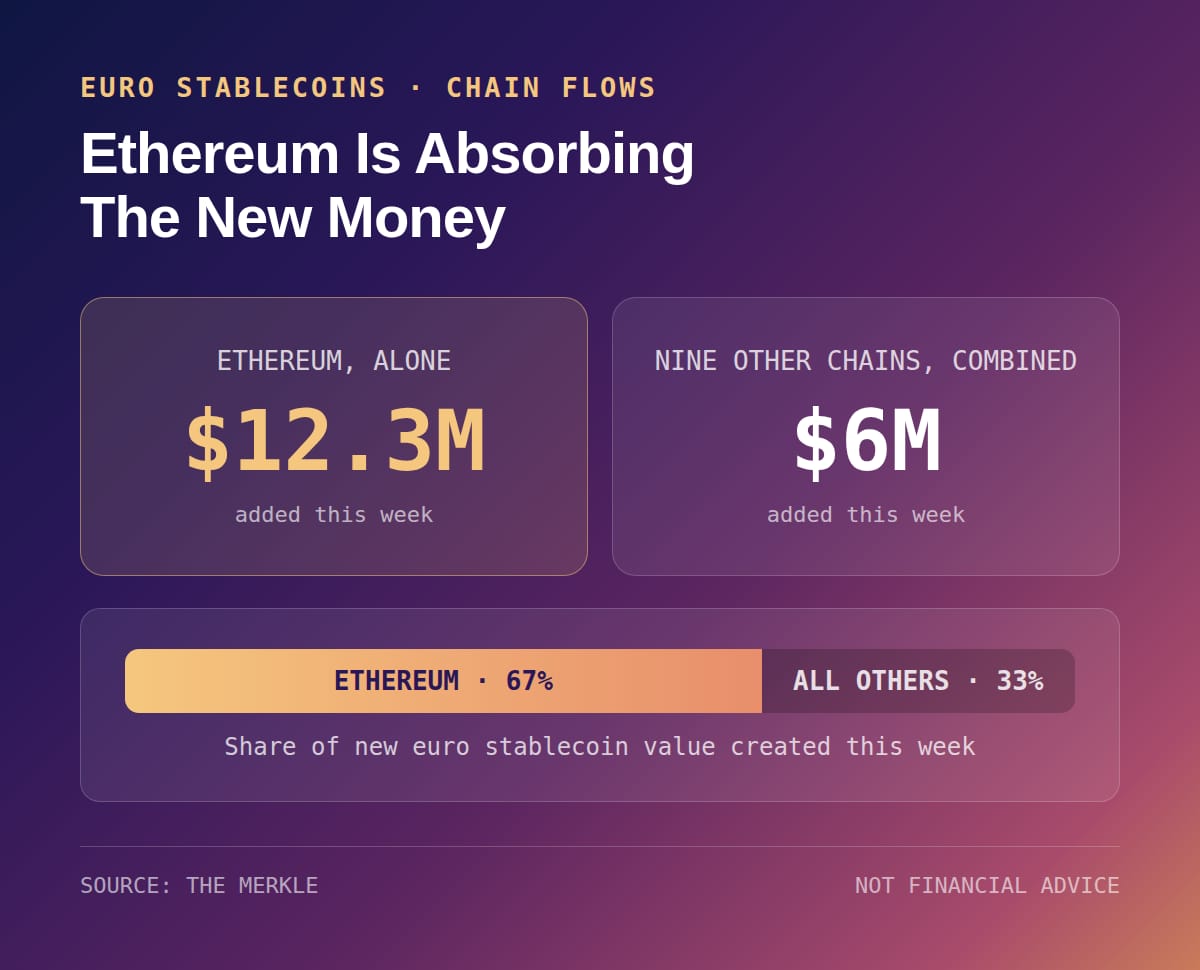
The chain-level data tells a similarly lopsided story. Euro stablecoin market cap on Ethereum increased by $12.3 million over the past week. Every other chain combined, nine of them in total, added just $6 million between them.
In other words, Ethereum alone captured roughly two-thirds of all new euro stablecoin value created this week, despite euro stablecoins being deployed across a genuinely wide spread of networks at this point, including Solana, Polygon, Avalanche, XRP Ledger, and Stellar. That pattern lines up neatly with the token-level story above. EURCV, EURC, and EUROP all maintain a significant presence on Ethereum, and if that’s where the bulk of this week’s institutional and DeFi-driven demand landed, it makes sense that the chain itself would show the deepest gains.
It’s also a reminder that multichain expansion, while good for accessibility and marketing, doesn’t automatically translate into balanced liquidity growth. Issuers can deploy on ten networks and still watch nine of them absorb a fraction of what the original chain pulls in.
Why EURC and EUROP are still Keeping Pace
It would be a mistake to read this week’s numbers as EURCV lapping the field. EURC and EUROP still posted meaningful growth in their own right, just not quite at EURCV’s pace. Circle’s EURC continues to benefit from Circle’s broader stablecoin infrastructure and its expanding presence across networks like Base, while Schuman Financial’s EUROP leans on its French ACPR licensing and KPMG-audited reserve structure to appeal to institutions that want regulatory clarity above all else.
What this week really shows is less a rout and more a widening gap between a small group of tokens with real distribution and a longer tail of euro stablecoins that are technically live but not yet capturing meaningful weekly flow. That’s a normal pattern in early-stage markets, and it’s one worth watching as more entrants show up.
Revolut’s EURR Still A Rounding Error, But It’s Growing
Then there’s the newest entrant to the conversation. Revolut’s euro stablecoin, EURR, has reached a market cap of $290.8 thousand, with $585.8 thousand transferred over the past 30 days across Ethereum and Polygon. Those numbers are tiny next to EURCV’s tens of millions in weekly movement, and they should be read as such. EURR only recently began rolling out to customers in a handful of European markets, so this is closer to a pilot phase than a real market test.
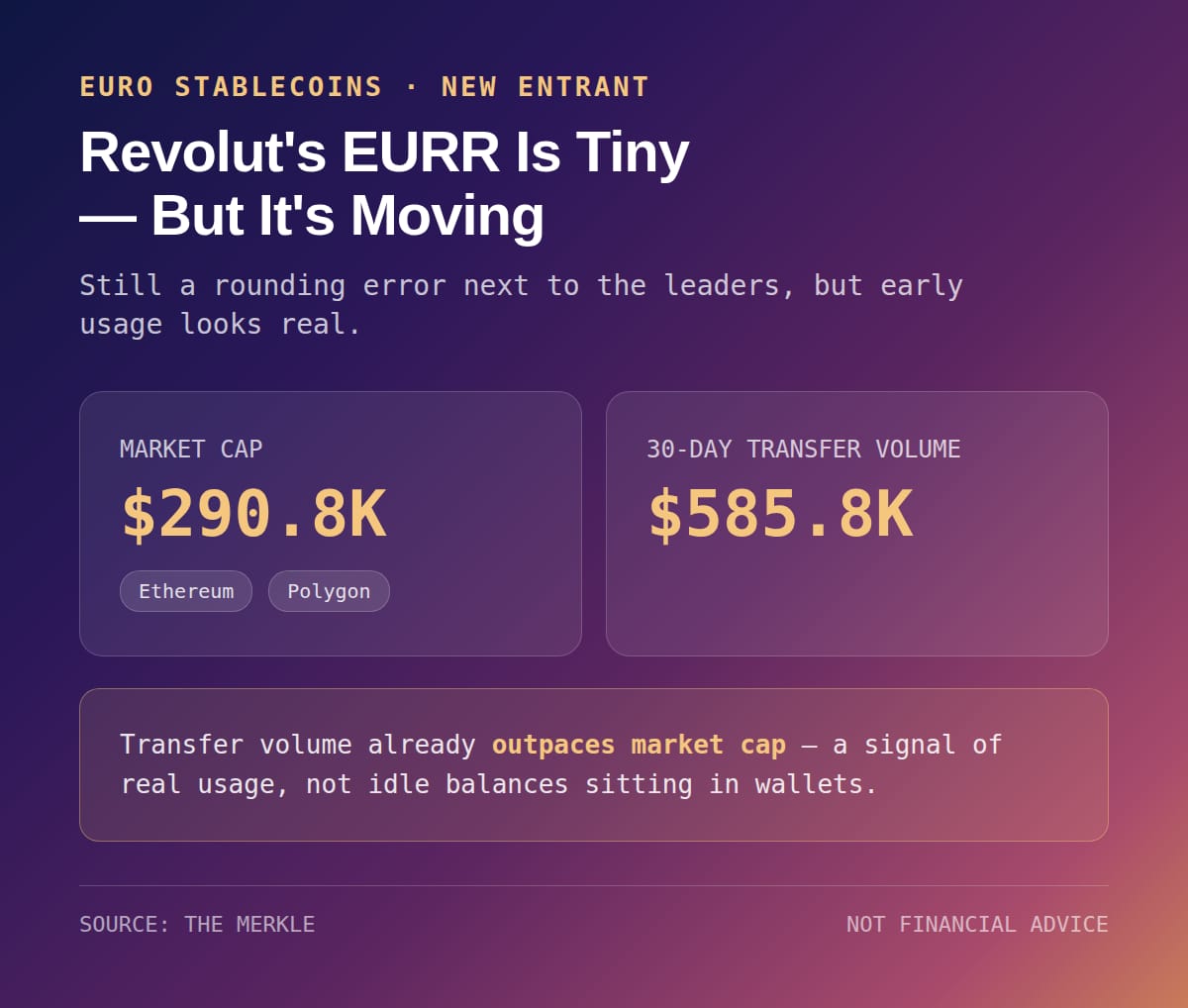
What makes EURR worth tracking isn’t its current size, it’s the distribution behind it. A euro stablecoin plugged directly into a retail banking app with tens of millions of existing users has a very different growth ceiling than one that only lives inside crypto-native wallets. Whether that translates into meaningful market share is still an open question, but the transfer volume already outpacing the market cap suggests actual usage, not just idle balances sitting in a handful of wallets.
What This Concentration Says About Europe’s Stablecoin Race
Zoom out, and the picture that emerges is a market still figuring out its winners. A 92% concentration of weekly growth in just three tokens, and two-thirds of new value landing on a single chain, isn’t the sign of a mature, evenly distributed sector. It’s the sign of a race that’s still very much being decided, where regulatory credibility, chain presence, and existing distribution networks matter more than how many blockchains a token’s logo appears on.
Euro stablecoins remain a small fraction of the overall stablecoin market compared to their dollar-pegged counterparts, but weeks like this one show where the early momentum is actually concentrating. For now, that’s Societe Generale’s EURCV, Circle’s EURC, Schuman Financial’s EUROP, and, in the background, an app-based challenger in EURR that’s just getting started.
Disclosure: This is not trading or investment advice. Always do your research before buying any cryptocurrency or investing in any services.
Follow us on Twitter @themerklehash to stay updated with the latest Crypto, NFT, AI, Cybersecurity, and Metaverse news!