
Unlike the countless new blockchains whose initial hype fades within a month, Robinhood Chain isn’t following that typical script.
Barely three weeks after its public mainnet went live, developers are building on it faster than most infrastructure I’ve tracked this year, and after digging into why, I don’t think it’s hard to understand the pull.
Robinhood Chain is an Ethereum layer 2 backed by Robinhood, built on Arbitrum using what’s called the Orbit stack, a framework that lets developers launch their own customizable layer 2 or layer 3 chains rather than building consensus infrastructure from scratch. It went live on July 1, and its core product is a new generation of tokenized stocks and ETFs built to trade around the clock and plug directly into onchain applications. Here’s what’s actually pulling developers toward it.
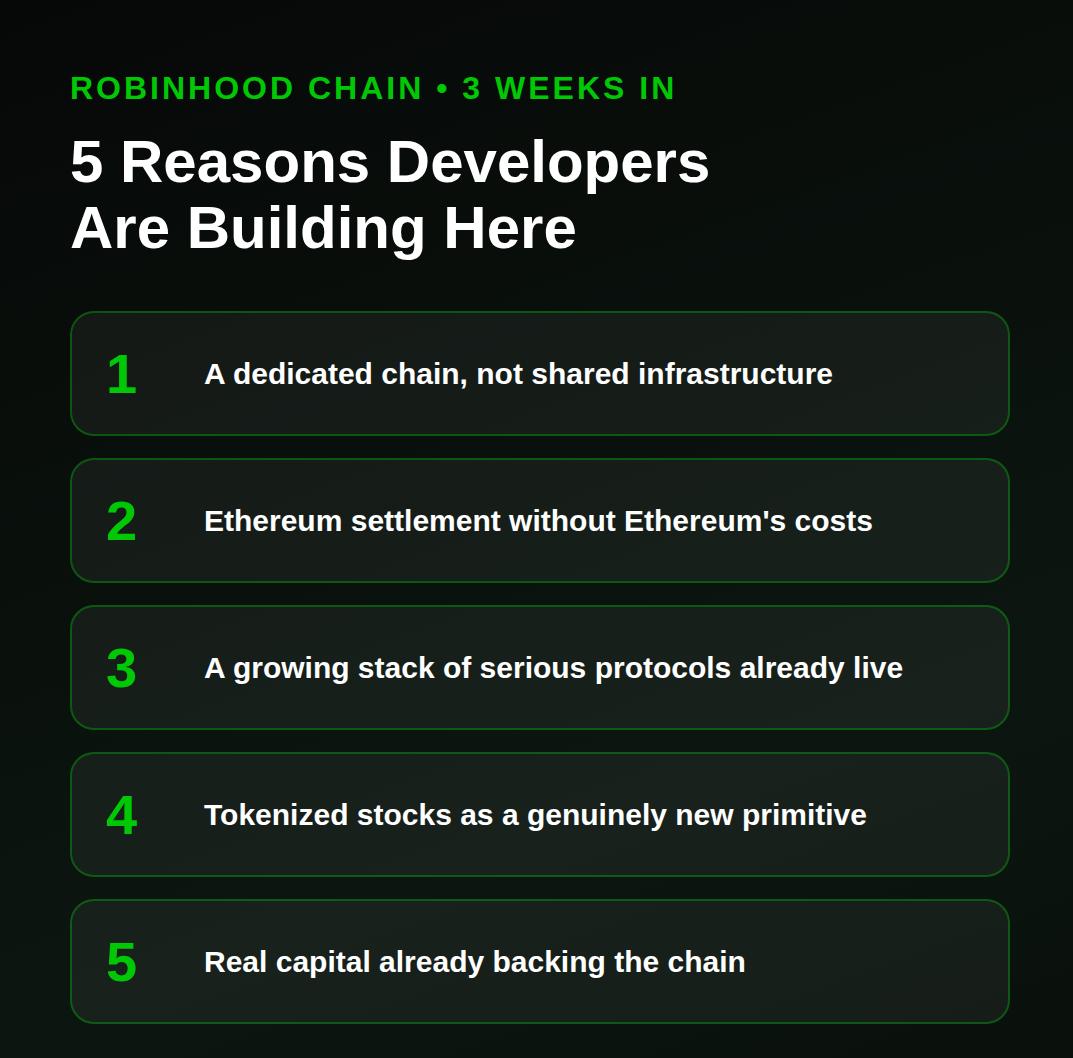
Reason One: A Dedicated Chain Instead Of Shared Infrastructure
Robinhood’s first tokenized stock products launched on Arbitrum One back in 2025, which gave the company access to an established layer 2 along with its liquidity and developer ecosystem. But building on shared infrastructure means competing for block space and gas efficiency with every other application on that network. I think this is the detail most people underestimate: general-purpose chains are optimized for nothing in particular, which makes them fine for most things and ideal for very few.
Robinhood Chain flips that arrangement. Instead of sharing a general-purpose network, Robinhood built a dedicated layer 2 optimized specifically around its own priorities, tokenized real-world assets, fast execution, predictable fees, and financial applications built to handle serious transaction volume. For developers building anything adjacent to that use case, launching on infrastructure tuned for exactly their problem is a meaningfully different proposition than fighting for space on a general-purpose chain.
Reason Two: Ethereum Settlement Without Ethereum’s Costs
The chain still settles to Ethereum, meaning transactions get processed away from Ethereum’s main network, batched together, and posted back to it for final settlement and data availability. That architecture is what lets Robinhood Chain offer lower fees and faster execution while still inheriting Ethereum’s security guarantees rather than building a trust model from zero.
I think this matters more to developers than to end users, honestly. Building on a chain that settles to Ethereum means tapping into an enormous existing pool of tooling, auditors, and infrastructure that already understands how to secure and interact with Ethereum-settled systems. That’s a real head start compared to building on an entirely novel base layer with unproven security assumptions.
Reason Three: A Growing Stack Of Serious Protocols Already Live
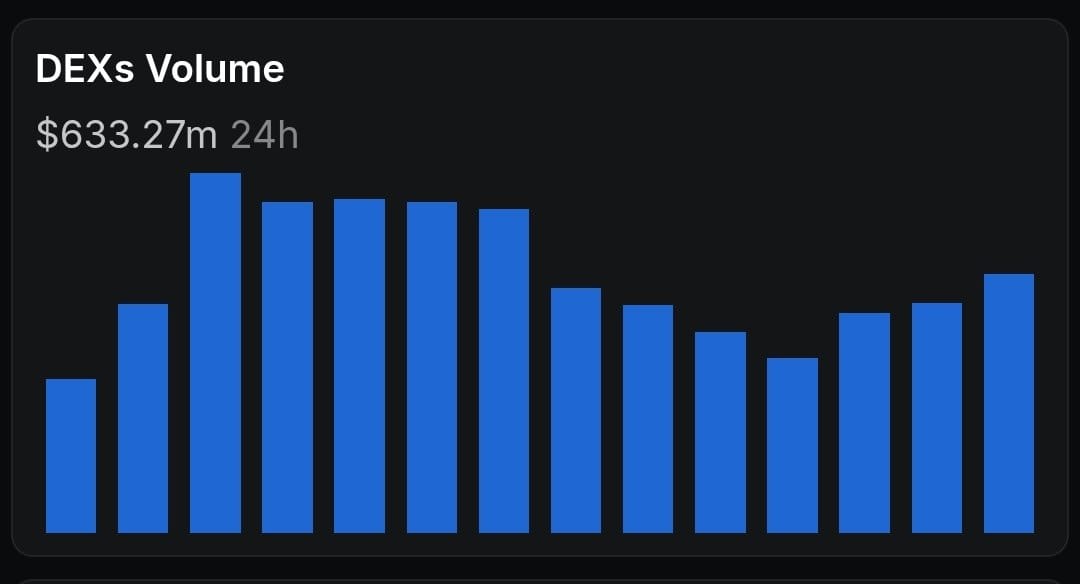
Developers don’t build in a vacuum. They build where composability already exists, and Robinhood Chain has assembled a legitimate lineup faster than I expected for a chain this young. Uniswap is live as the chain’s core decentralized exchange. Arcus handles both spot DEX activity and perpetual trading. Rialto operates as a DEX and liquidity aggregator. Morpho brings lending and borrowing infrastructure. Lighter adds another perpetual trading venue. HoodMemes rounds it out as a dedicated memecoin launchpad.
I think this lineup tells its own story. It’s not a chain waiting for its ecosystem to show up. It’s a chain that launched with enough serious DeFi infrastructure already in place that a new protocol building here today has real liquidity and composability to plug into immediately, rather than trying to bootstrap an ecosystem from nothing.
Reason Four: Tokenized Stocks Give Builders A Genuinely New Primitive
The standout feature pulling developers in is tokenized stocks, real-world equities available onchain that can be used as collateral or lent out to earn yield. That’s not a feature most chains can offer, because it depends entirely on Robinhood’s existing regulatory and brokerage infrastructure sitting underneath the chain itself.
For a developer building a lending protocol, a structured product, or any application that wants exposure to real-world assets rather than purely crypto-native collateral, that’s a genuinely novel building block. I think this is the single biggest differentiator Robinhood Chain has over the dozens of other layer 2s competing for the same DeFi developers. Nobody else launching a general-purpose L2 can plug in real equities as a native onchain asset class this cleanly.
Reason Five: Real Capital Is Already Backing The Chain
None of the above matters much without actual capital behind it, and this is where the numbers get interesting.
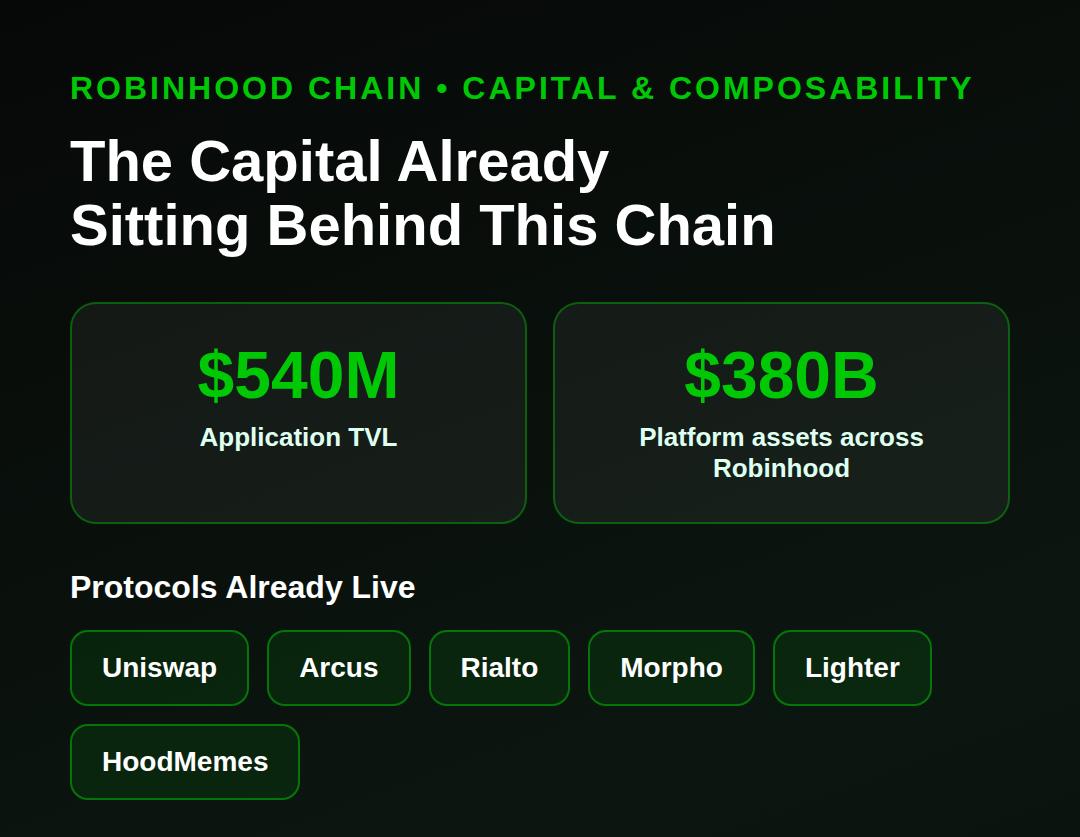
According to data shared by Token Terminal, Robinhood Chain currently shows $540 million in application TVL against $380 billion in platform assets sitting across Robinhood’s broader business.
As more of that platform’s assets move onchain over time, applications built on the chain gain access to a progressively larger onchain capital base.
I think that $380 billion figure is the real reason developers are paying attention. Most new chains have to convince capital to show up organically. Robinhood Chain has an enormous existing user base and asset pool sitting one step away from onchain, which means any protocol built here isn’t betting on hypothetical future liquidity. It’s positioning early for capital that has a clear, plausible path onto the chain as Robinhood continues shifting more of its platform onchain.
How To Actually Use What’s Already Built
For anyone wanting to interact with the chain directly rather than build on it, the entry points are already straightforward. You can send and receive digital assets, trade tokens at low fees, interact with dApps, and access DeFi directly through an ecosystem built to be simple to navigate. Buying a token specifically means connecting a wallet to a supported DEX like Uniswap, Arcus, or PancakeSwap on Robinhood Chain, selecting the token and amount, and confirming the swap after reviewing the transaction details. I’d always verify a token’s official contract address before buying anything, regardless of which chain you’re on, since that single habit prevents most scam losses I’ve seen reported.
Worth noting: Robinhood Chain has no native token of its own. Gas is paid in ETH, consistent with how most Ethereum layer 2 networks operate. There’s no NPRO-style token play here, no airdrop speculation baked into the chain’s basic function, just ETH as gas, the same as using any other established L2.
Why This Combination Is Pulling Developers In
I don’t think any single one of these five reasons would be enough on its own to explain the pace of building happening on Robinhood Chain right now. A dedicated L2 without real capital behind it is just another chain competing for attention. Tokenized stocks without composable DeFi infrastructure already in place would be a novelty feature rather than a genuine building block. It’s the combination, purpose-built infrastructure, Ethereum-grade settlement, an already-live protocol stack, a genuinely new asset class, and a massive capital base with a clear onchain migration path, that’s making this chain worth building on right now rather than waiting to see how it plays out.
Disclosure: This is not trading or investment advice. Always do your research before buying any cryptocurrency or investing in any services.
Follow us on Twitter @themerklehash to stay updated with the latest Crypto, NFT, AI, Cybersecurity, and Metaverse news!