
For five years, the joke about UNI was that it was the most successful DeFi token that had never earned a cent for anyone holding it.
Billions in trading fees flowed through Uniswap and none of it touched the token. Then the fee switch flipped, and the chart in front of me looks like a different asset entirely. It’s the kind of bar chart you don’t need an explanation for: a run of modest green blocks from January to July, then August jumps, then September towers over everything that came before it. Revenue season has arrived, and it’s showing up in public data.
September Is On Track To Be Uniswap’s Highest Holders Revenue Month Ever
DefiLlama’s holders revenue chart for Uniswap tells the story at a glance. After a token-holder revenue of almost nothing in December, monthly figures sat in a range of roughly $3 million to $5 million from January through July. August then leapt to around $9.3 million, and September has already climbed to about $14.7 million with the month still open. That’s more than double the pre-summer run rate and around 60% above August, which was itself a record at the time.
The rolling numbers back it up. DefiLlama’s main Uniswap page currently shows $15.67 million in protocol revenue over the last 30 days, out of $207.64 million in total fees, and an annualized revenue rate of about $70 million. Calendar-month and rolling-30-day figures aren’t the same thing, which is why they differ slightly, but they point the same way: the fee switch is finally producing serious money.
How The Money Actually Reaches UNI Holders
It’s worth being precise about what “holders revenue” means, because it isn’t a dividend. Under the UNIfication proposal, approved by governance in December 2025, a slice of swap fees is diverted to the protocol instead of going entirely to liquidity providers. Those fees collect in vault contracts called TokenJar, and a second contract called Firepit makes them redeemable only in exchange for UNI that is destroyed. DefiLlama tracks this as buy-and-burn revenue.
The practical effect is that fee income shrinks the UNI supply rather than landing in wallets as cash. Uniswap’s own documentation is explicit that holders have no direct claim on protocol revenue, so the value accrues through scarcity, not payouts. That’s a real distinction, and it’s why “$15 million in buybacks” is an accurate shorthand but not the same as $15 million paid to holders.

What’s Driving The Revenue Surge
Several forces stacked up at once, and they’re all visible in the on-chain record.
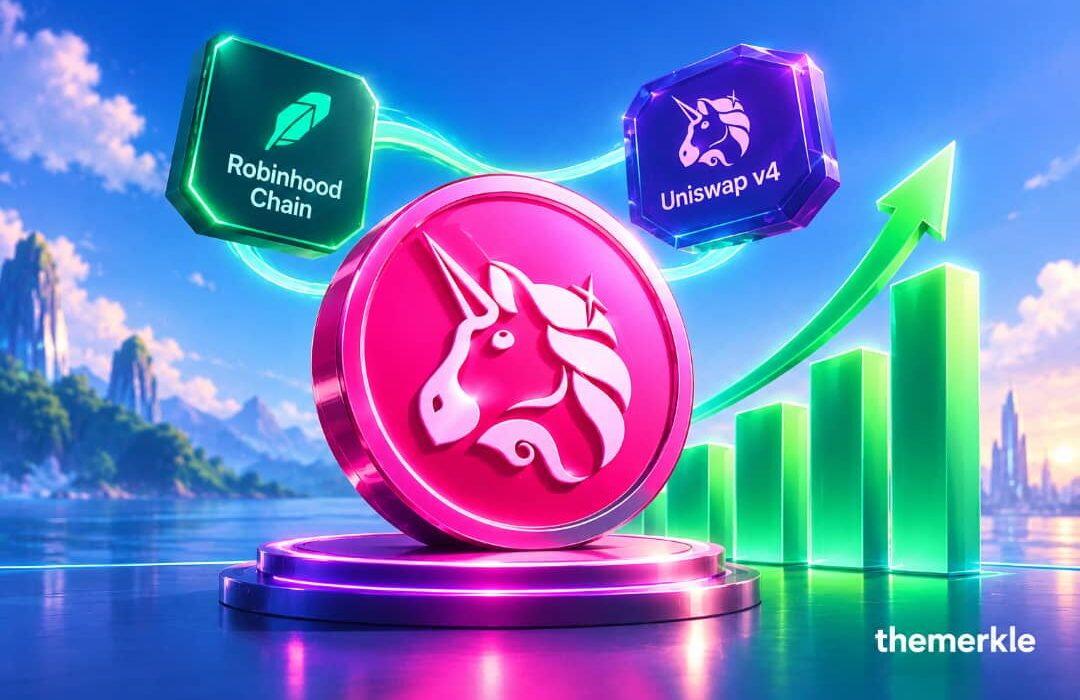
The fee switch kept spreading. It went live on Ethereum on December 28, 2025, then expanded to Optimism, Arbitrum, Base, Zora, and X Layer in March. Polygon, BNB Chain (BSC), and Celo followed on June 2, and on July 27 it reached Robinhood Chain. That last step also switched fees on for Uniswap v4 pools, which by DefiLlama’s account had been generating volume without contributing to holder revenue. Each expansion widened the pool of fees that could be captured.

Volume moved to where the fees are now collected. Uniswap handled about $81.3 billion of volume over 30 days, with v4 at roughly $43 billion, edging past v3. A large share came from Robinhood Chain, which alone accounted for around $33 billion. Because the fee switch was extended to Robinhood Chain and v4 in late July, this new volume started feeding the burn almost immediately, which matches the timing of the August and September jumps on the chart.

Momentum fed on itself. UNI has rallied hard, trading near $9 in recent days after closing around $5.84 on September 1. Reports have also linked the move to regulatory developments around tokenized stocks in automated pools. Nobody can cleanly separate cause from coincidence there, and higher token prices don’t create revenue on their own, but stronger sentiment tends to bring more trading activity, and more trading means more fees.
Why This Matters Beyond One Good Month
Records get attention, but what I find more interesting is the shape of the trend. Holders revenue didn’t creep up gradually. It stepped up each time the fee switch reached a new chain or pool type, which suggests the underlying business is healthy and the earlier numbers were held back by configuration, not demand. For a protocol with roughly $3.9 billion in total value locked and nearly $1 billion in annualized fees, capturing even a modest share of that is meaningful.
There’s a valuation angle too. At a market capitalization of around $5.5 billion, UNI’s annualized revenue of about $70 million still implies a rich multiple, which is why skeptics point out that the token only recently began earning anything. Bulls counter that revenue is growing fast from a low base and that the recurring burn is compounding on a fixed supply. Both camps are looking at the same chart.
Disclosure: This is not trading or investment advice. Always do your research before buying any cryptocurrency or investing in any services.
Follow us on Twitter @themerklehash to stay updated with the latest Crypto, NFT, AI, Cybersecurity, and Metaverse news!